


 ‘You do not negotiate at gunpoint’: Brahma Chellaney on why Singapore fared better than India
Geostrategist Brahma Chellaney on Monday questioned the structure of the India–US interim trade agreement, arguing that India ended up with immediate and monitored commitments while the United States secured expanded access to the Indian market.
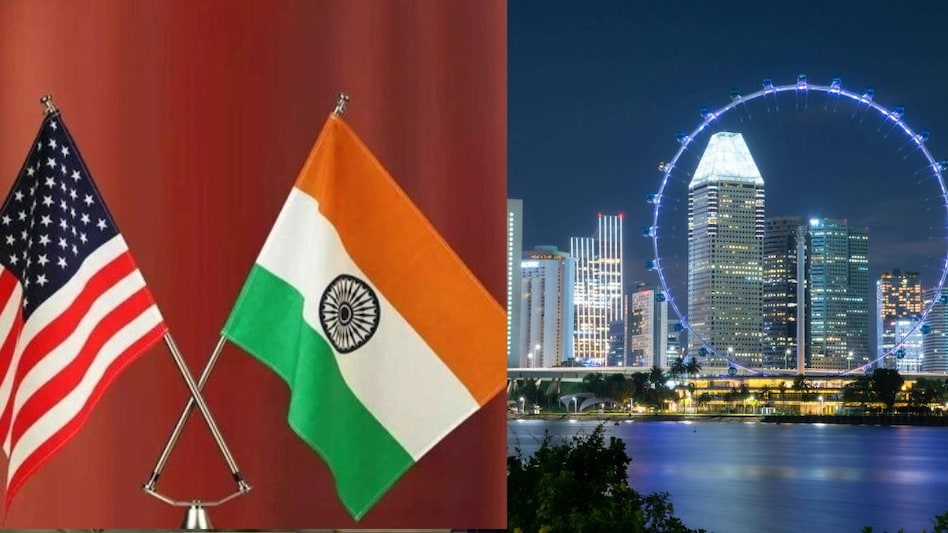
Speaking at a panel discussion at India Today, he compared India's 18% reciprocal tariff with the 10% baseline tariff imposed by the US on Singapore, and asked why a smaller country appeared to have negotiated better terms.
"How is it that tiny Singapore faces only a 10% US tariff. And India, after all these concessions as part of the interim trade deal, will face 18% tariff. Why?" he asked. He invoked what he called a cardinal principle of negotiations. "In fact, one of the cardinal principles of international negotiations is that you do not negotiate at gunpoint. You don't negotiate when the other side has imposed sanctions or unveiled threats against you."
Chellaney, a professor of strategic studies at the Centre for Policy Research in New Delhi, pointed out that the United States negotiated with India while India was under 50% punitive tariffs for six months. "It was in this 6-month period where India made these concessions," he said. He urged attention to the structure of the pact.
"But now look at the structure of the deal. The structure is very important in this deal. India's concessions are immediate and quantified. The American concessions are conditional or largely corrective, such as a reduction of previously imposed penalties. Indian commitments are to be monitored. US commitments are reversible," he said.
According to him, for India, the arrangement restores access that had been withdrawn, while for the United States, it opens up fresh opportunities. He sharpened the comparison further: "Washington today is essentially charging India an 18% fee to enter the American market while demanding India open its own market for zero fee. This is the essence of the deal."
Returning to Singapore, the professor asked, "How is it that Singapore is a better negotiator than India? Why don't we learn from smaller countries how to negotiate?"
Chellaney argued that negotiating under pressure limited India's leverage. "How do you negotiate with America when you are under withering 50% tariffs? You try to be a good boy. You refuse to have any counter tariffs imposed on the US. You decide that you will negotiate while under those draconian tariffs. The result is what we see today."
What the interim agreement says
On February 7, Washington and New Delhi announced a framework for a reciprocal and mutually beneficial Interim Agreement.
Under the terms outlined in the joint statement, India will eliminate or reduce tariffs on all U.S. industrial goods and a wide range of U.S. food and agricultural products, including dried distillers' grains (DDGs), red sorghum for animal feed, tree nuts, fresh and processed fruit, soybean oil, wine and spirits, and additional products.
In return, the United States will apply a reciprocal tariff rate of 18 per cent, down from 25%, on originating goods of India. New Delhi has also stated its intention to purchase $500 billion of US energy products, aircraft and aircraft parts, precious metals, technology products, and coking coal over the next five years. The two sides will significantly increase trade in technology products, including Graphics Processing Units (GPUs) and other goods used in data centers, and expand joint technology cooperation.
The Singapore comparison
The United States has imposed a 10% baseline tariff on imports from Singapore. By contrast, India, a much larger economy, faces an 18% reciprocal tariff under the interim framework.

 Exam reforms: Tech titan Nandan Nilekani picked by PM Modi to fix national public examination system
  'Tax officers struggled for own land': Nirmala Sitharaman slams laidback attitude of govt depts
 CBDT issues new crypto reporting guidance: No new tax, but exchanges must track and report all transactions
 Did Cockroach Janta Party's 'Chalo Sansad' 2.0 threat trigger Dharmendra Pradhan's resignation? What we know so far
 'Will discharge my responsibilities with complete humility': Pralhad Joshi after being appointed Education Minister
 AI Data Centers, Aerospace & Gas Turbines: What's Powering Indo-MIM's Future Growth?
 Best Healthcare Stocks: Gaurang Shah's Outlook On Apollo Hospitals, Fortis & The Manipal Health IPO
 Is Indo-MIM's IPO Valuation Justified? Here's Why The Company Sees Strong Growth Ahead
 Treasury Bills Explained: Why T-Bills Are One Of The Safest Short-Term Investment Options
 FDs vs Markets: Where Should You Keep Your Short-Term Money?
 Gland Pharma stock: Price target of Rs 3,250 likely in medium term, says analyst
  Metal recycling stocks to buy: Gravita, Pondy Oxides, Jain Resource among top picks
 TRIL shares: Should you average the falling stock? Here's 'fixed and final' stop loss
 Adani Power: 45 GW target, Rs 2 lakh crore capex plan among conference call highlights
  ITC Hotels, Chalet, Ventive, IHCL, SAMHI: Hotel stocks to buy despite travel disruptions
 Beyond mutual funds: Why analysts see SBI Funds' alternative asset business as a long-term growth engine
 'Ashamed of it...': Manoj Muntashir calls Adipurush his biggest mistake, seeks country's forgiveness Exam reforms: Tech titan Nandan Nilekani picked by PM Modi to fix national public examination system 'Tax officers struggled for own land': Nirmala Sitharaman slams laidback attitude of govt depts
 Delhi targets traffic bottlenecks on Aruna Asaf Ali Marg with ₹1.97 crore elevated road study









