












 Despite the rapid EV growth story, petrol vehicles continue to dominate India’s insured vehicle mix with a 68.3% share, followed by diesel vehicles at 24.7%. AI Generated Image
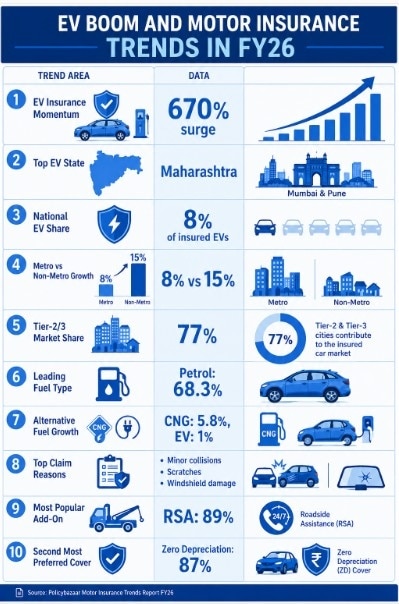
India’s electric vehicle (EV) insurance segment emerged as the fastest-growing category in the country’s motor insurance market in FY26, reflecting the rapid expansion of electric mobility and changing consumer preferences. According to a Policybazaar analysis, EV insurance policies recorded a massive 670% surge between 2025 and 2026, making it the fastest-growing segment in the industry.
The sharp rise comes amid increasing EV adoption, rising awareness around specialized insurance products, and stronger consumer confidence in electric mobility solutions. The report suggests the trend marks a broader shift in India’s vehicle ownership landscape, where EVs are steadily becoming a mainstream consideration for urban consumers.
Maharashtra leads
Maharashtra led the EV insurance boom in FY26, emerging as India’s largest market for insured electric vehicles. The report noted that Mumbai and Pune became major growth hubs and together helped Maharashtra account for 8% of insured EV cars nationwide.
The growth reflects the state’s expanding EV ecosystem, stronger charging infrastructure, and growing demand for EV-focused protection products. Insurance offerings for electric vehicles increasingly include battery-related coverage and specialized benefits designed for EV ownership.
MUST READ: What does Bajaj Life Smart Secure ROP offer for insurance buyers?
Motor insurance market
The broader motor insurance industry also maintained healthy momentum during FY26. The car insurance market recorded 8% year-on-year growth, driven largely by new vehicle purchases and improving awareness around financial protection.
Other segments posted even stronger gains. Two-wheeler insurance expanded by 11%, while commercial vehicle insurance grew 13% during the year, indicating broader growth across vehicle categories.
The data suggests rising mobility demand and increasing willingness among consumers to opt for insurance coverage beyond mandatory requirements.
MUST READ: Claim-free year can mean years of savings: Everything you need to know about no claim bonus
Tier-2 and Tier-3 cities
A major shift in FY26 came from smaller towns and cities. While metro cities reported 8% growth in insured car adoption, non-metro markets saw significantly stronger growth of 15%.
Tier-2 and Tier-3 cities now contribute 77% of India’s insured car market, up from 75% last year, highlighting deeper insurance penetration beyond India’s largest urban centres.
The trend reflects growing digital adoption, improved access to online insurance platforms, and increasing awareness among consumers in smaller markets.
MUST READ: Is geopolitical uncertainty driving more Indians to buy travel insurance in 2026?
Petrol vehicles dominate
Despite the rapid EV growth story, petrol vehicles continue to dominate India’s insured vehicle mix with a 68.3% share, followed by diesel vehicles at 24.7%.
Alternative fuel categories are gradually expanding. CNG vehicles now account for 5.8%, while EVs currently represent 1% of the insured base, indicating that although EV penetration remains small, growth momentum is accelerating rapidly. LPG vehicles continue to remain a niche category with a 0.2% share.
Add-On covers
Customer preferences are also evolving beyond basic coverage. The report found that Roadside Assistance (RSA) and Zero Depreciation (ZD) emerged as the most preferred add-ons among vehicle owners during the first three years of ownership, with adoption levels of 89% and 87%, respectively.
According to Policybazaar, India’s motor insurance market is entering a more mature phase, with non-metro demand, EV-focused products, and customization emerging as key drivers of future growth.
MUST READ: Selling your old car? Have you secured your No Claim Bonus before it expires?

 US Senate bill proposes 100% tariffs on India over Russian oil: What it could mean
 Warren Buffett changed his mind twice on Big Tech: First Apple, now Alphabet
 India-UK CETA kicks in: Kolkata ships first jewellery exports to Britain with zero import duty
 Nifty Pharma hits record high; Divi's Labs, Torrent Pharma, Sun Pharma shares shine
  Cabinet approves Semicon 2.0 with budget outlay of ₹1.27 lakh crore
 Q1 Earnings Beat Expectations: Ambareesh Baliga Bets Big On These Bank Stocks
 Silver Crashes 16% In A Month! Should You Buy The Dip? Expert Explains
 Why Has India Stopped Buying Gold & Silver? Expert Explains The Real Reasons
 Copper Ready For A Comeback? Expert Predicts Fresh Rally Despite China Slowdown
 Gold Price Outlook: Will West Asia Tensions Push Gold Higher? Fed, Oil & Safe Haven
 Nifty Pharma hits record high; Divi's Labs, Torrent Pharma, Sun Pharma shares shine
  Sensex, Nifty close higher; Eternal, UltraTech, SBI among top gainers
  Bharti Airtel shares: Should one buy this telecom stock ahead of Jio IPO?
 HDFC AMC Q1 earnings: Net profit rises to Rs 837 crore, stock closes higher
  BEL share price: Defence stock may face resistance at Rs 430-440, says Vishnu Kant Upadhyay