


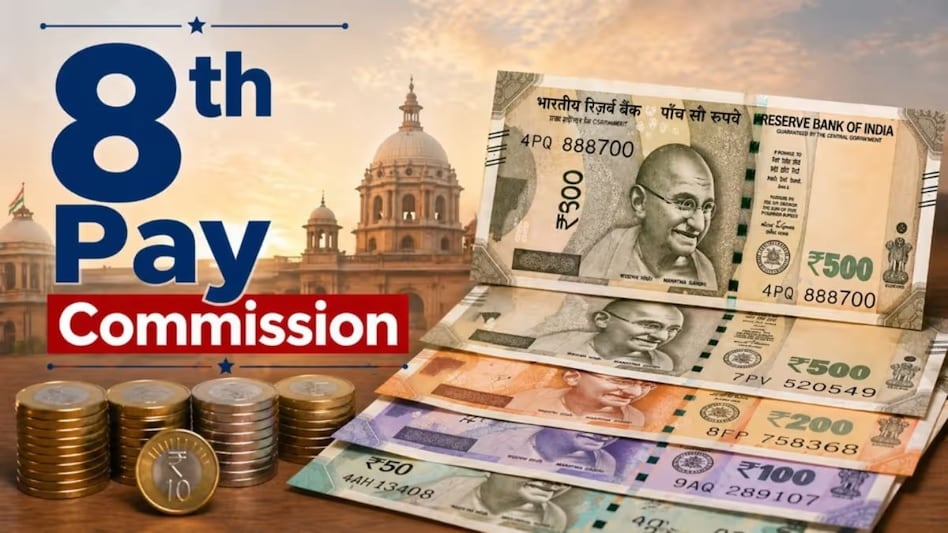
 The 8th Pay Commission has begun consultations with employee unions, pensioner groups and government departments across the country.
8th Pay Commission: The fitment factor has emerged as one of the most important topics in discussions around the 8th Pay Commission, as it will determine the extent of salary revisions for millions of central government employees and pensioners. While the commission is still consulting employee associations and stakeholder groups, proposals submitted so far indicate that expectations for a substantial pay hike remain high.
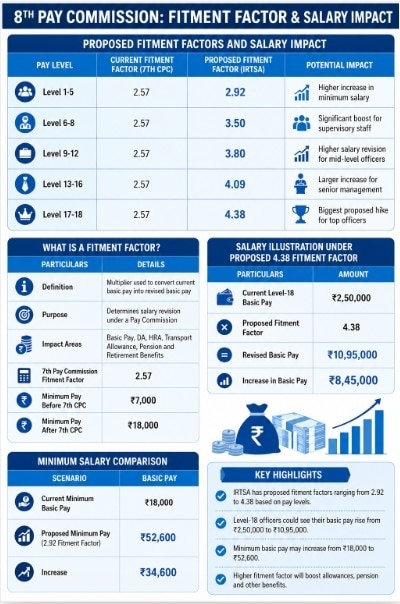
One of the most ambitious suggestions has come from the Indian Railway Technical Supervisors' Association (IRTSA), which has proposed fitment factors ranging from 2.92 to 4.38, depending on an employee's pay level. If accepted, the proposal could lead to one of the largest salary revisions seen under any Central Pay Commission.

 N Chandrasekaran exit: Uncertainty looms over Tata AGM; here's what experts say
 'Quality at a reasonable price': HSBC picks Tata Motors, M&M as its top 2 auto stock ideas
 Former Air India CEO Campbell Wilson appointed as director on Air New Zealand board
 NPS, annuities and mutual funds: How should investors build a retirement income strategy?
 Sustainable packaging to be 10-30% costlier, says Zomato's chief sustainability officer
 7 Types Of Income That Are Taxable For Senior Citizens | Tax Guide | Personal Finance | Money Today
 Market Commentary | Jitendra Sriram On Markets, Stocks & Outlook
 What’s Hot: Stocks, Gold & Big Money Moves | Daily Markets Show | August 19 | Business Today TV
 Electronics & IT Minister Ashwini Vaishnaw Reveals 4 Pillars Driving India’s Growth Story
 Pakistan’s New Somalia Strategy: Is Islamabad Eyeing A Bigger Role In The Indian Ocean?
 BTTV Exclusive | Growth is back after 4-5 quarters but may taper in H2, says Jitendra Sriram
 Banking, insurance, IT, realty shares could offer high returns post Q1 earnings season; here's why
  RIL, IREDA, LIC, Muthoot Finance, Tata Steel, Hindustan Copper: JM Financial's Akshay Bhagwat shares views
 India becomes Asia's least-preferred market, replaces Indonesia: BofA poll 'Quality at a reasonable price': HSBC picks Tata Motors, M&M as its top 2 auto stock ideas
 ₹7 lakh EDLI payout explained: How EPFO calculates insurance benefits for families
 China moves to replace Microsoft Windows from state agencies to cut US tech dependency
 Can Delhi’s canals become power plants? What Master Plan 2047 says on solar, hydro energy generation
 Tech layoffs weigh on India’s real estate market as housing sales fall 6% in Q2BTTV Exclusive | Growth is back after 4-5 quarters but may taper in H2, says Jitendra Sriram