





Search
Advertisement
FD investment strategy: Should you choose a 1-year, 3-year or 5-year deposit?

FD investment strategy: Should you choose a 1-year, 3-year or 5-year deposit?

Fixed deposit rates vary across banks, small finance banks and NBFCs, with the highest returns not always available on longer tenures. Comparing one-year, three-year and five-year rates can help investors build an FD ladder that balances returns, liquidity and reinvestment risk.

Business Today Desk
Business Today Desk
  • Updated Oct 24, 2026 7:15 PM IST
FD investment strategy: Should you choose a 1-year, 3-year or 5-year deposit? FD laddering involves splitting investments across deposits with different maturity dates instead of committing the entire amount to a single tenure.

With banks, small finance banks and non-banking financial companies (NBFCs) offering different interest rates across tenures, investors face a key decision when putting money into fixed deposits (FDs): should they lock in their savings for one year, three years or five years? One strategy that can help balance returns and liquidity is FD laddering, which involves splitting investments across deposits with different maturity dates instead of committing the entire amount to a single tenure.

Advertisement

The approach allows investors to access portions of their money at regular intervals while reducing the risk of having to reinvest their entire corpus when interest rates are lower.

How do FD rates compare across tenures?

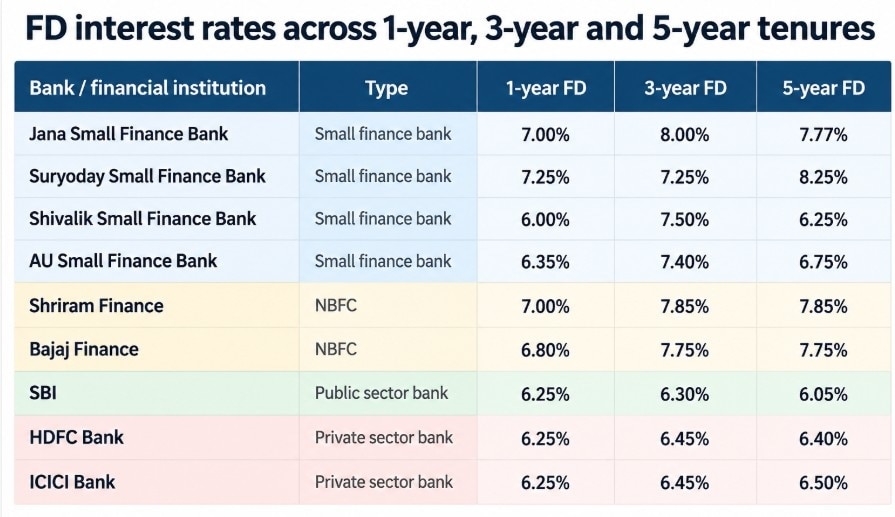
Data compiled by Stable Money as of October 21, 2026, shows that interest rates vary considerably across institutions and deposit periods. Among the institutions covered, Jana Small Finance Bank offers 7% on one-year deposits, 8% on three-year deposits and 7.77% on five-year deposits for regular investors.

Shriram Finance offers 7% on one-year deposits and 7.85% on both three-year and five-year deposits. For senior citizens, the rates are 7.50% for one year and 8.35% for three- and five-year deposits on the listed tenures.

Advertisement

Suryoday Small Finance Bank offers 7.25% on one-year and three-year deposits, rising to 8.25% for five-year deposits. However, these rates are institution-specific, and investors should check the applicable terms before investing.

MUST READ: REITs, InvITs and AIFs: Can alternative investments diversify your portfolio?

The comparison shows that longer tenures do not always guarantee higher returns. The most attractive rate may be available for a particular period, making it important to compare rates across the full tenure rather than simply choosing the longest deposit.

How does FD laddering work?

Advertisement

Suppose an investor has ₹3 lakh to invest. Instead of placing the entire amount in a five-year FD, the investor could divide it into three deposits of ₹1 lakh each, with maturities of one, three and five years.

When the one-year deposit matures, the proceeds can be reinvested at the prevailing rate or used to meet expenses. The three-year deposit provides another opportunity to reassess interest rates and financial needs, while the five-year deposit retains exposure to its original rate for longer.

The allocation can be adjusted depending on the investor's cash-flow requirements and financial goals. Investors should also check whether a bank offers the required tenure and whether premature withdrawal attracts a penalty.

ALSO READ: Nifty vs FD: What ₹1 crore invested at past market bottoms would be worth today

What should investors consider before locking in rates?

Saurabh Jain, Co-Founder and CEO of Stable Money, said investors should compare available returns and choose deposits that align with their financial goals, investment horizon and liquidity requirements.

Laddering can reduce reinvestment risk by spreading maturity dates, but it cannot eliminate it. If rates fall, maturing deposits may have to be reinvested at lower rates. If rates rise, money locked into longer-term deposits may earn less than newly available FDs.

Advertisement

Safety is equally important. Eligible bank deposits are insured by the Deposit Insurance and Credit Guarantee Corporation (DICGC) up to ₹5 lakh per depositor per bank, including principal and interest. NBFC deposits do not carry DICGC insurance, so investors should assess the issuer's creditworthiness before chasing higher rates.

Ultimately, a one-year FD may suit investors who need flexibility, while longer deposits can help those seeking predictable returns. An FD ladder can offer a middle path by balancing access to funds with the opportunity to lock in attractive rates across different tenures.

DO READ: RBI hikes repo rate: Your FD could pay more, but bonds may take a hit. What investors should know

ABOUT THE AUTHOR

Business Today Desk
Business Today Desk

Business Today brings you the latest news, views and analysis from the world of finance, economy, markets, corporates, startups, tech, and the digital economy. You can find everything from breaking news to deep dives to immersive essays and more on a variety of subjects across all formats - online, magazine, television, data visualisation, et al.

Published on: Oct 24, 2026 7:15 PM IST