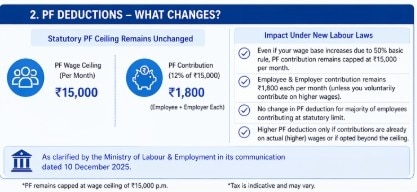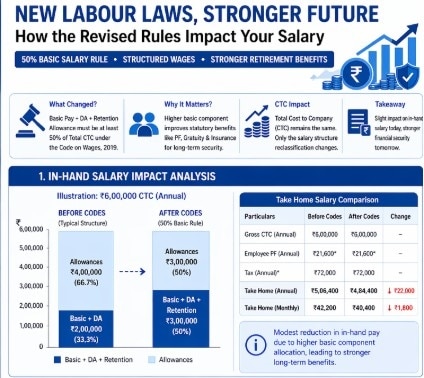



 According to experts, under the new labour law framework, the basic salary, dearness allowances & retaining allowances is required to be at least 50% of total CTC.
 The new labour laws that came into effect from April 1 are set to significantly reshape salary structures for millions of salaried employees, with a clear shift in emphasis from immediate take-home pay to long-term financial security. At the core of this reform is a standardised definition of “wages,” which mandates that basic pay, dearness allowance (DA), and retention allowance together must constitute at least 50% of an employee’s total compensation.
This structural change directly impacts how salaries are broken down, and consequently, how statutory benefits such as provident fund (PF), gratuity, and insurance contributions are calculated. While the overall cost to company (CTC) remains unchanged, the reallocation within salary components is expected to alter monthly in-hand income for many employees.

 ₹8,862 crore in tolls! This state emerged as India's biggest highway toll revenue generator
 Could India witness a Korea-style market meltdown? Nithin Kamath explains the biggest risk
 How Indian investment overseas is gathering momentum
 Semicon 2.0, space, hydrogen trains: How manufacturing push is gaining pace, shows July's economic review
 To stay ahead, Indian manufacturers are embracing AI
 PSU Stocks Outlook: Can Defence, Power & Industrial PSUs Deliver Strong Returns Ahead?
 "Normal Law & Order": JP Nadda Hits Back At Kharge Over Police Action On Student Protesters!
 Parliament's Most Viral Debate Yet? How Gen Z Language Entered Lok Sabha
 Anti-Paper Leak Bill Passed Amid Massive Row Over Rahul Gandhi's Pellet Gun Claim
 Assam Flood Crisis: Top Explosive Ground Visuals Of Devastation & Rescue!
 Could India witness a Korea-style market meltdown? Nithin Kamath explains the biggest risk
 Dabur India Q1 results: Profit up 15% at Rs 591 crore YoY; revenue climbs 11%
 FIIs could return to market in six months, says Ajay Bagga
  Sensex, Nifty climb over 1% each; investors add Rs 4 lakh crore in wealth
 Banks, IT, defence, power stocks likely to lead FY27 earnings upgrades, says Ajay BaggaPSU Stocks Outlook: Can Defence, Power & Industrial PSUs Deliver Strong Returns Ahead?"Normal Law & Order": JP Nadda Hits Back At Kharge Over Police Action On Student Protesters!Parliament's Most Viral Debate Yet? How Gen Z Language Entered Lok SabhaAnti-Paper Leak Bill Passed Amid Massive Row Over Rahul Gandhi's Pellet Gun Claim
 'Most interesting intellectual cluster in India': Sanjeev Sanyal praises IIT Madras, Prof Kamakoti