Yet, even as rivals double down on the format, the decision of one of its earliest movers to walk away points to a larger industry tension.
If audience demand is growing and fresh capital continues to flow into the sector, what explains the retreat?
Where does the money come from
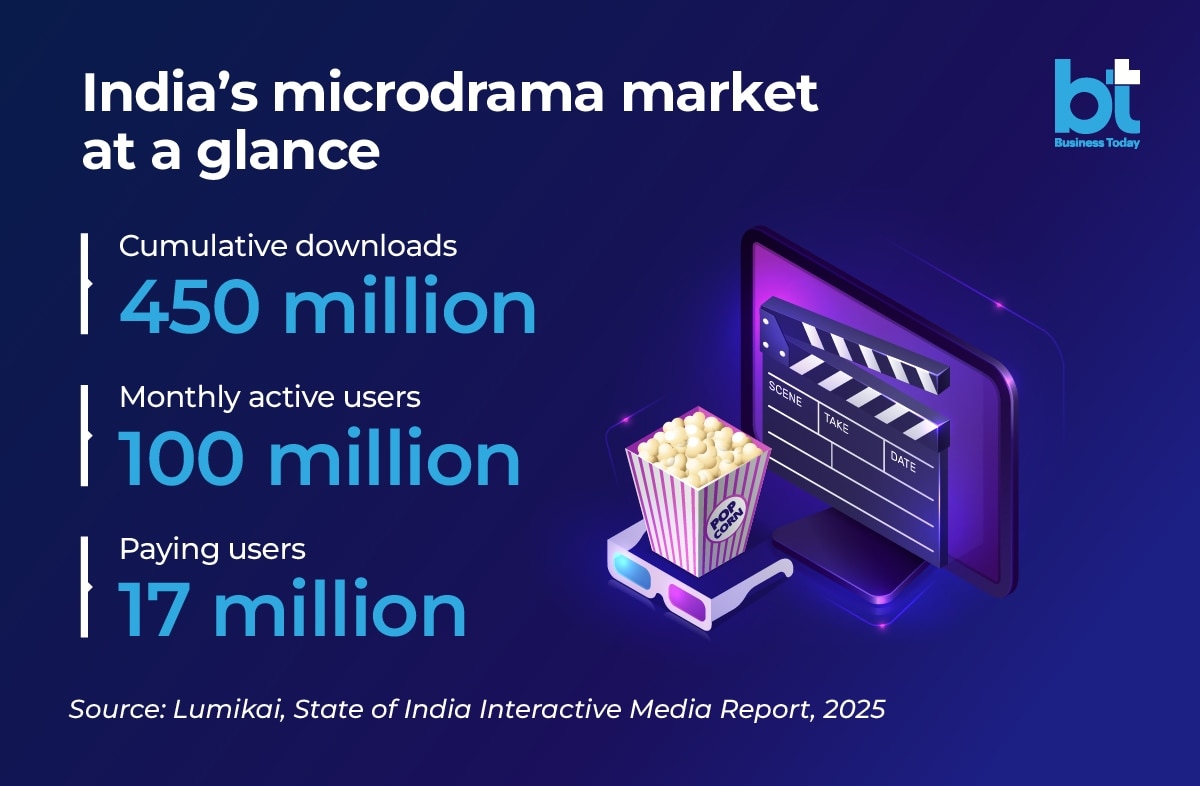
Instagram and YouTube are flooded with short-form vertical video content, proving that India has emerged as one of the world's fastest-growing markets for microdrama and vertical-video apps. According to industry estimates, India became the largest market globally for short-drama app downloads, recording over 21 million installs in a single month. Lumikai estimates the category has already crossed 450 million cumulative downloads.
The numbers suggest there is no shortage of demand for the format, and its popularity is not difficult to explain. India is one of the world's largest mobile internet markets, data remains among the cheapest globally, and years of scrolling through Instagram Reels and YouTube Shorts have already conditioned viewers to consume entertainment in short bursts.
However, audience interest may not naturally translate into profits. Microdrama platforms typically rely on a mix of revenue models. Most allow viewers to watch the opening episodes for free before asking them to unlock subsequent chapters using virtual coins, subscribe for unlimited access or watch advertisements to continue. The approach resembles mobile gaming more than traditional television, where a small but engaged segment of users contributes a disproportionate share of revenue. The model has worked in markets such as China, but whether it can be replicated at scale in India's more price-sensitive digital ecosystem remains an open question.
While most players publicise downloads and watch time, few disclose profitability. That makes it difficult to ascertain whether user growth is translating into sustainable returns.
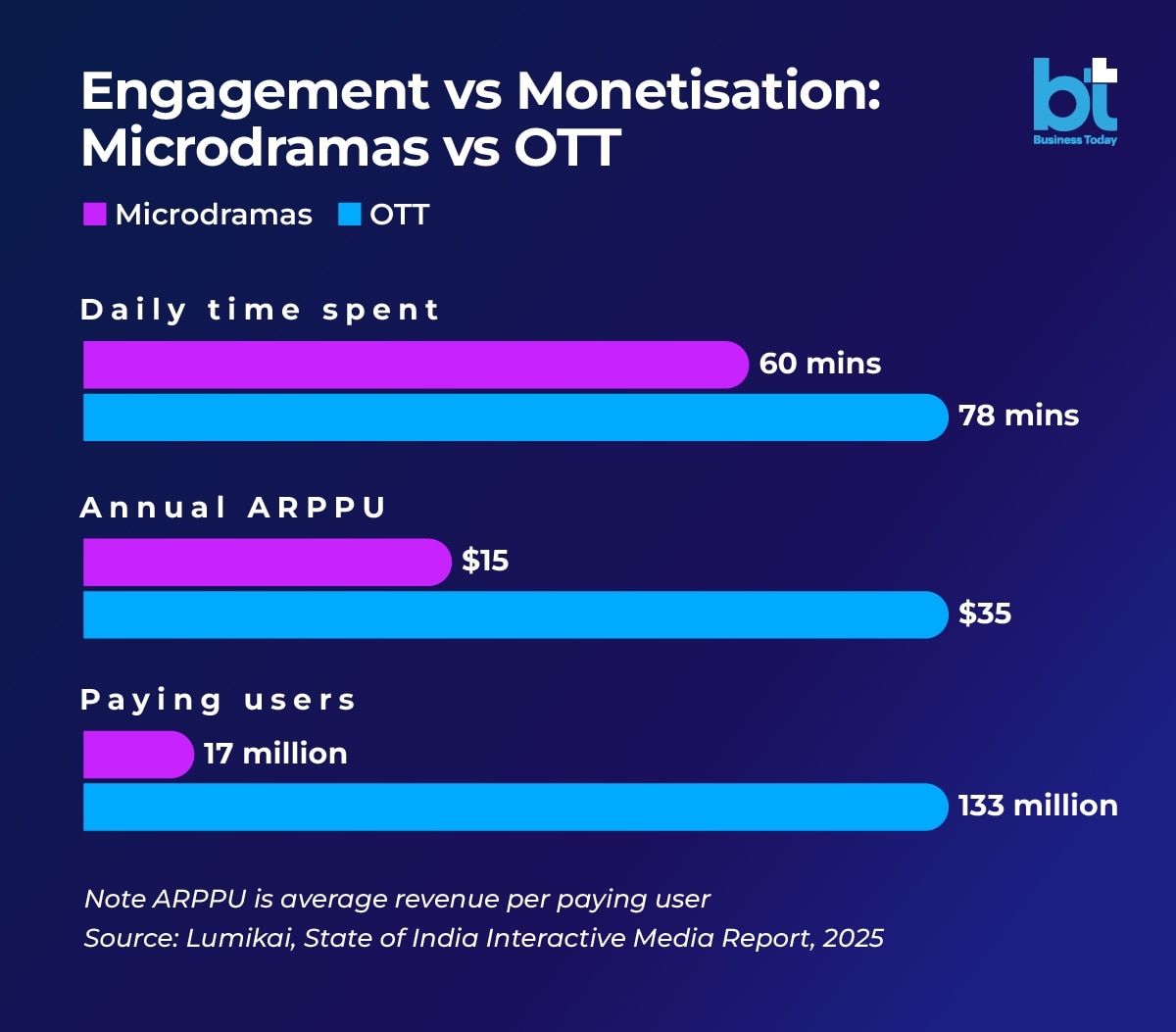
The contrast is reflected in the numbers. According to Lumikai, users spend around 60 minutes a day on microdrama apps, close to the 78 minutes spent on over-the-top (OTT) platforms. Yet average revenue per paying user remains significantly lower at $15, compared with $35 for OTT services.
Platforms are already experimenting with different ways to convert that engagement into revenue. Some rely on subscriptions, others on virtual coins and pay-per-episode purchases, while several are combining advertising with paid access. A few have also begun partnering with telecom operators, bundling access with mobile plans to reach users who may be reluctant to subscribe directly. The variety of approaches underlines an industry that is still searching for the most effective commercial model.
Rising competition
Unlike premium OTT originals and conventional television, microdramas do not require large production budgets or lengthy development cycles. Technology is accelerating this shift. AI-assisted workflows are reducing the time required for scripting, dubbing, localisation and editing, allowing platforms to produce larger volumes of content across multiple languages. Lower production costs make experimentation easier, but they also reduce barriers to entry. As creating content becomes simpler, attracting and retaining audiences becomes a more difficult competitive advantage.
The short video segment has players such as Kuku FM's Kuku TV, Amazon MX Player's MX Fatafat, ZEE Entertainment Enterprises' Bullet, alongside startups such as ReelSaga, Quick TV, Story TV, Chai Shots and others. Chinese-origin heavyweights like ReelShort and DramaBox have also entered with dubbed catalogues.
As more companies enter the category, the challenge shifts from creating content to getting noticed. Food delivery, edtech, and OTT platforms all experienced similar phases in which competition intensified, and distribution became as important as the product itself.
While Pocket FM has attributed its decision to prioritise audio as a strategic refocus, its exit comes at a time when the microdrama market is becoming crowded. However, audio also offers structural advantages over video. Production costs are significantly lower, stories can be released at a faster pace, and successful titles often have a longer shelf life because they are not tied to expensive visual production. Pocket FM has also invested heavily in AI tools to speed up scripting, localisation and publishing. According to the company, these tools have reduced content-creation timelines by more than 90%, enabling creators to release episodes more quickly and monetise them sooner.
The China Playbook
China has already established that the format can become a thriving entertainment business.
It emerged from China's "duanju" ecosystem before spreading globally. Platforms such as ReelShort and DramaBox have demonstrated that mobile-first storytelling can generate substantial revenues through subscriptions, coin systems, and pay-per-episode models.
China's experience showed not just that audiences enjoyed the format, but that they were willing to keep paying for it. Instead of relying solely on monthly subscriptions, many platforms built businesses around frequent, low-value purchases, encouraging viewers to unlock one episode after another. That commercial model has since travelled beyond China, with platforms adapting it for markets in the US, Southeast Asia and, increasingly, India.
Former Hollywood studio executives, venture investors and even major entertainment companies are investing in microdrama platforms. Media reports suggest that Disney selected DramaBox's parent company for its accelerator programme.
Despite the global success, India presents a different challenge.
The download data indicates that Indians are interested in melodrama as a genre, but it says little about their willingness to pay. Unlike China, where users have shown a greater willingness to pay for serialised digital content, historically, Indian digital entertainment has been advertising-led and price-sensitive. Monetisation remains the Achilles' heel of most content businesses.
Even Netflix, which entered India with premium pricing, was eventually forced to rethink its strategy and introduce lower-cost plans to broaden adoption. That reality is shaping business strategy across the sector. Rather than relying on a single source of revenue, platforms are increasingly mixing subscriptions, advertising and distribution partnerships to broaden their reach while lowering the barrier to payment. The focus has shifted from simply attracting viewers to finding pricing models that work in a market where free alternatives are plentiful.
India has already demonstrated that there is an audience for microdramas. What remains unsettled is the business model. The platforms that crack pricing, distribution, and monetisation will shape the next phase of the industry. Until then, downloads and watch time will tell only part of the story.















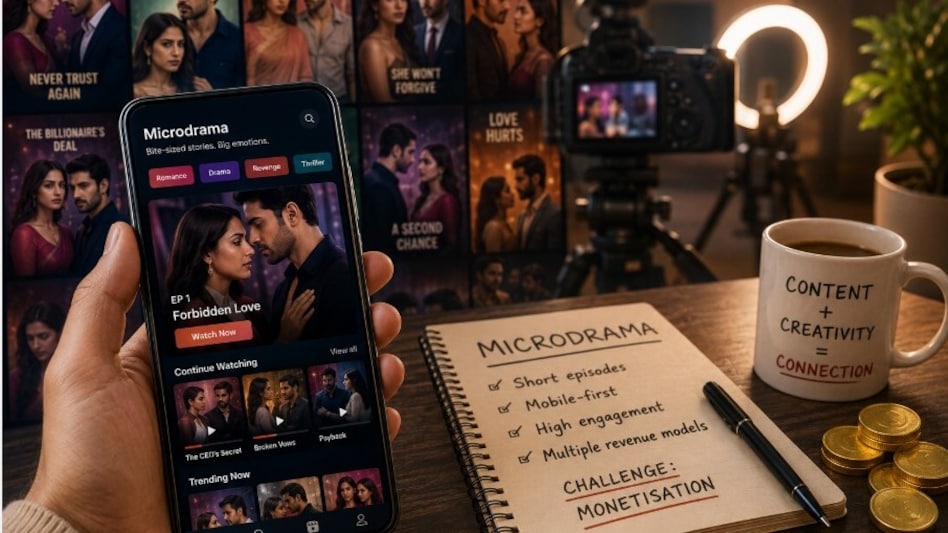 Instagram and YouTube are flooded with short-form vertical video content, proving that India has emerged as one of the world's fastest-growing markets for microdrama and vertical-video apps.
 BT India@100: ‘India has not lost the AI race,’ says Amitabh Kant, highlights the country’s biggest advantage
 Will Tukaram Mundhe enter politics? Here's what the Maharashtra FDA commissioner said
 Sensex CAS manipulation: Thin liquidity exposes vulnerability; what's ahead?
  Apple vs OpenAI: Legal battle escalates as iPhone maker rejects dismissal plea
 ‘2 out of 3 canteens didn't have licence’: Tukaram Mundhe on why Maharashtra FDA raided Bombay High Court
 #IndiaAt100 | Amitabh Kant On The Future Of ‘Make In India’: Can India Become A Global Factory?
 #IndiaAt100 | Manufacturing Jobs In The AI Age: What Will The Future Workforce Look Like?
 #IndiaAt100 | Manufacturing: The Engine That Could Power India’s 2047 ‘Viksit Bharat’ Dream
 #IndiaAt100 | Swapan Dasgupta On West Bengal’s Growth Story: Can It Power India’s Next Leap?
 #IndiaAt100: MeitY Secretary S. Krishnan On Building Bharat’s Aatmanirbhar Tech Stack
 Renewable stock to buy: Recent debutant in bear grip after multibagger rise; Ventura sees 55% rally
 STT now accounts for 27% of retail derivatives costs, up from 13% in FY22
 Nobel Hygiene files IPO draft papers with Sebi; plans Rs 150 crore fresh issue, OFS
 HDFC Bank shares to see 57% upside? Bernstein targets for ICICI, Axis, KMB, SBI, IIB
 Bitcoin price today: Rs 16 lakh gain just in a week! What led to a sharp rally in crypto market?
 BT India@100 | Mumbai went vertical, Gurgaon built a private metro: DLF's Aakash Ohri on what Indian cities must do before 2047