The unprecedented demand comes as France battles record-breaking heat that has shut thousands of schools, strained hospitals, disrupted transport and even reduced electricity production from nuclear power plants because rivers used for cooling have become too warm.
Cooling appliances disappear from stores
Retailers across France report a sharp spike in sales of fans, portable air-conditioners and cooling equipment as households try to cope with relentless daytime temperatures and tropical nights that offer little relief.
MUST READ | 40°C heatwaves, 282 deaths so far: Why does Europe still have so few ACs?
Construction firms have shifted work to dawn hours, while businesses are adjusting schedules to protect employees from dangerous heat exposure. Delivery companies have also issued fresh safety protocols for outdoor workers as demand for cooling products continues to surge.
The rush reflects a dramatic shift in consumer behaviour in a country where air conditioning has historically been uncommon compared with countries like the United States.
Why France never embraced AC
Unlike much of North America or parts of Asia, France has long relied on passive cooling rather than mechanical air conditioning.
Several factors contributed to this:
- Traditionally mild summers reduced the need for AC.
- Many French homes are decades or even centuries old, making retrofitting expensive.
- High electricity prices discouraged widespread cooling.
Environmental concerns made many people view air conditioning as a contributor to climate change.
DON'T MISS | Zero-cooling crisis: How 40°C became India’s irreversible new summer normal
Even this month, surveys showed that eight in ten French people still considered air conditioning environmentally unfriendly, although attitudes are now beginning to shift as extreme heat becomes more frequent.
Heatwave forces a rethink
The current heatwave has pushed France into emergency mode.
Authorities have activated the highest heat alerts across large parts of the country, closed around 3,500 schools and shortened operating hours at thousands more. National school examinations have continued under special arrangements that include water distribution, wider seating and emergency cooling measures. The government has also released funding to purchase cooling equipment for schools.
Beyond education, the heat has affected almost every sector.
Power generation has been disrupted as high river temperatures reduce the efficiency of nuclear reactors. Farmers are reporting losses of poultry and falling milk production, while transport networks and public infrastructure are operating under significant stress.
Climate change is reshaping the debate
Climate scientists say Europe is warming faster than any other continent, making severe heatwaves longer, more frequent and more intense.
Experts argue that while passive cooling measures — better insulation, shading, ventilation and urban greenery — should remain the first line of defence, air conditioning is increasingly being viewed as a necessary public-health tool, especially for hospitals, schools, care homes and vulnerable populations.
DO CHECKOUT | Europe heatwave turns severe: France curbs public drinking, UK braces for June record
France's largely low-carbon electricity system also means the climate impact of cooling is lower than in countries that depend heavily on fossil fuels, although concerns remain over energy demand and refrigerant emissions.
A new normal for Europe?
What was once considered an occasional summer inconvenience is increasingly becoming a defining feature of European life. The frantic hunt for fans and air-conditioners across France illustrates how rapidly public attitudes can change when extreme weather becomes routine.
For visitors from countries where ACs are considered essential, Europe's limited adoption of cooling systems can seem puzzling. Even, the world's first trillionaire Elon Musk has shed focus on this anomaly. But the answer lies in a mix of history, architecture, economics, and culture — factors that shaped a continent built to survive cold winters rather than scorching summers.
IN CASE YOU MISSED IT | Heatwave in Antarctica? Temperatures soar 20°C above normal alarming scientists
A catastrophic "Omega block" heatwave is currently sweeping across Europe, shattering temperature records and directly causing hundreds of premature deaths, fatal drownings, and severe infrastructure disruptions. As of June 2026, the ongoing European heatwave has officially claimed at least 282 lives across the continent.



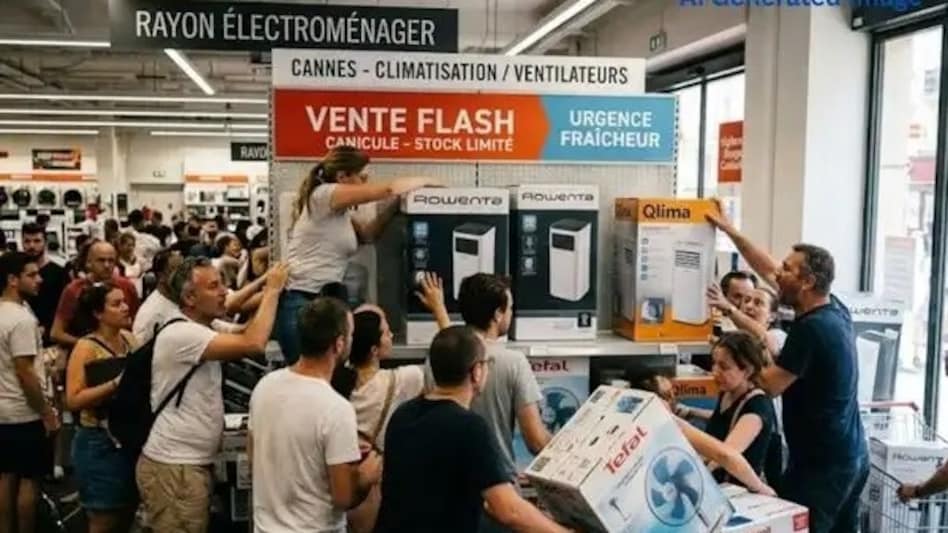 Climate scientists say Europe is warming faster than any other continent, making severe heatwaves longer, more frequent and more intense.
 Apple launches iPhone 18 Pro, iPhone 18 Pro Max: Brings upgraded performance, camera, and more
 The iPhone folds! Apple unveils its first-ever foldable ‘iPhone Duo’ at Rs 2,99,900
 Apple AirPods 5 launched with best-in-class ANC, Siri AI and Live Translation
 'Comparing apples and oranges': CBIC responds to Subhash Garg's claim on GST growth
 Apple Watch Ultra 4 launched with new health sensing, 45-hour workout battery and AI features
 Tata Curvv EV: First Look At The Tech-Packed Electric SUV
 IDBI Bank Stake Sale: Fairfax Bid, ₹53,000 Cr Valuation & Deal Delay Explained
 Adani Group Plans $2.5 Billion Offshore Loan To Refinance Cement Acquisition Deb
 Sugar Exports Under Pressure: Tight Stocks, Ethanol Diversion & Weather Risks Cloud
 Brent Crude Crosses $100: India’s Oil Basket Hits $108.9; What It Means For Markets
 Index manipulation case: Sebi lifts trading ban on JPMorgan unit after Rs 2.96 crore deposit
 Dow considers exit from $20 billion Saudi Aramco chemicals venture Sadara
 Nifty IT tumbles 3%: Near-term trend weak; AI concerns, US rate worries weigh
 Cupid's Aditya Kumar Halwasiya ups stake again; buys 15 lakh shares
 ASM Technologies stock hits record high as RK Damani entity, Asha Mukul Agrawal back fund raising
 'If mahaprasad has to be stopped, tell us': Ganpati Mandals seek clarity on Maharashtra FDA food safety SOPs
 Have Rs 50 lakh in savings? Check Canara Bank’s new interest rate and what SBI, PNB, BoB offer
 This simple device is helping German renters cut their power bills
 Commercial real estate emerges as a credit hotspot despite higher risk weights: Report
 5 mutual funds bag five-star rating: How Invesco, HSBC, Axis and ITI funds performed












