


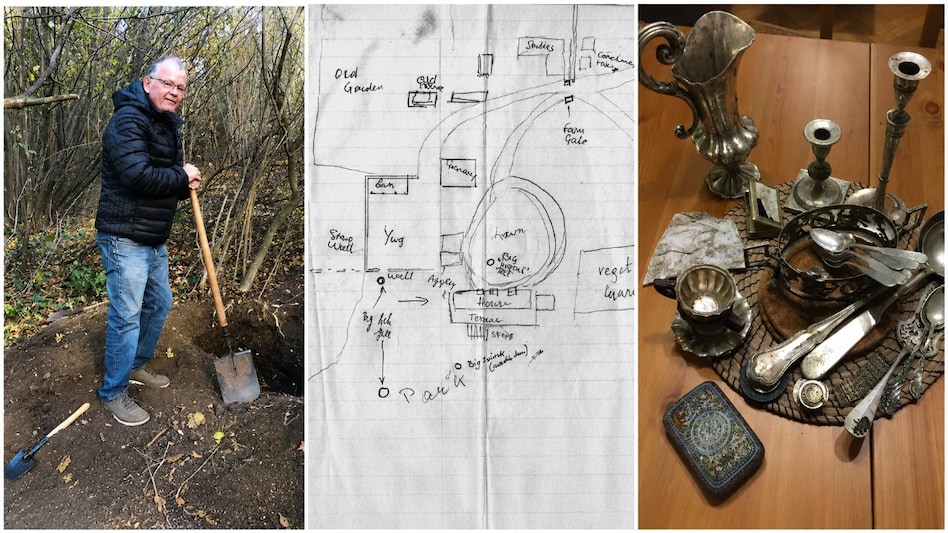
 The search became serious in 2019 when Jan, assisted by family members and local metal-detection experts, began working through the clues left behind by his father.(Image Credit :The Sun)
A hand-drawn map, sketched from memory and passed down through generations, has helped a family recover a treasure buried more than 80 years ago during the chaos of World War II, according to a report by The Sun.
The discovery brought to an end a decades-long search and reunited descendants with jewellery, silver and heirlooms hidden when war forced their family to flee their home.
Jan Glazewski spent years trying to fulfil a promise made to his late father. The search focused on the family's former estate in what was then eastern Poland, a region whose borders and political control changed dramatically during and after the war.
Don't Miss: 'My prayer to God, Vedanta should always remain a dividend-paying company' - Anil Agarwal
Family buried valuables as war approached
The story dates back to September 1939, when Soviet forces advanced through the region during the early days of World War II. Fearing the uncertainty ahead, members of the Glazewski family gathered their most valuable possessions and buried them on their estate before escaping.
Their plan was to return once the situation stabilised. That never happened.
The family's patriarch, Adam Glazewski, stayed behind while the rest of the family fled. The estate was eventually lost, and family members settled in different countries. His sons built new lives far from their former home, carrying only memories of the valuables left behind.
Over the decades, stories about the hidden cache survived within the family. Tales of buried silver, jewellery and treasured belongings were passed down through generations, but changing borders, wartime destruction and the passage of time made any attempt to locate them increasingly difficult.
A map drawn from memory
Years later, Jan's father, Gustaw Glazewski, decided to document what he remembered. In 1989, relying entirely on memories dating back more than 50 years, he drew a rough map showing where the treasure had been concealed.
The sketch was far from precise. Buildings had disappeared, landscapes had changed and vegetation had transformed the terrain. Even so, Gustaw included notes and directions he believed could one day help someone find the hidden valuables.
For Jan, the map became more than a set of instructions. It was a link to relatives he barely knew and a final request from his father, who died in 1991.
Political changes in Eastern Europe later made the search possible. After Ukraine gained independence, Jan was able to visit the former family estate, though matching the old sketch to the modern landscape proved challenging.
A years-long search
The search became serious in 2019 when Jan, assisted by family members and local metal-detection experts, began working through the clues left behind by his father.
The task was complicated by the fact that the property had changed beyond recognition. The manor house had long since been destroyed, pathways had vanished, fields had become overgrown and woodland had spread across parts of the estate.
There was also no guarantee the treasure was still there. It was entirely possible that someone had discovered the valuables decades earlier. Despite the uncertainty, the team continued searching.
Their persistence eventually paid off when a metal detector signalled beneath the soil.
Jewellery and heirlooms recovered after 80 years
What emerged from the ground was far more than a collection of valuables.
According to The Sun, the cache contained jewellery, family silver and personal possessions connected directly to earlier generations of the Glazewski family. Several items carried names, initials and engravings that helped confirm their origins.
One discovery was especially meaningful for Jan. He realised that some of the recovered objects had likely been packed by his mother before the family fled in 1939. She died when he was still a child, meaning he was holding possessions she had last touched more than eight decades earlier.
The recovery also included hunting guns and other family heirlooms that had survived underground through war, political upheaval and shifting national borders.
Although the collection has been valued at thousands of pounds, Jan says its true worth lies in its emotional significance. The discovery fulfilled a long-held family wish and completed a mission his father had entrusted to him many years ago.
The achievement is made even more remarkable by Jan's own personal struggles. According to The Sun, he survived an HIV infection caused by contaminated blood products received during haemophilia treatment.
More than 80 years after the treasure was buried, the discovery has not only recovered lost valuables but also restored a tangible connection to a family history interrupted by war, displacement and loss.

 Adani's airline push: Letter shows group wants to launch carrier, says report
 Should you buy every IPO? Research suggests patience may be the smarter strategy
 Mphasis shares: FY27 guidance maintained; brokerages keep 'Buy' after Q1; check target price
 'Getting IV drips every morning': Abhijeet Dipke says fight against Dharmendra Pradhan will go on
 New Tax Regime is changing how Indians think about home loans: Here's why
  Think Life Insurance Is Optional? Here's Why Every Indian Family Needs It Today
 FD Vs Arbitrage Fund: Which Is Better For High Taxpayers?
 Manipal Health Enterprises Sets Price Band For Rs 9,275 Crore IPO, Opens July 29
 "Sack Education Minister First": Rahul Gandhi Vs Rijiju Clash Locks Parliament Over NEET Debate
 Anti-Paper Leak Amendment Bill Approved: 10-Year Jail, ₹10 Crore Fine & Fast-Track Courts Planned
 ITC shares: Rs 307 a key short-term level to watch; here's target priceMphasis shares: FY27 guidance maintained; brokerages keep 'Buy' after Q1; check target priceShould you buy every IPO? Research suggests patience may be the smarter strategy
 Sensex, Nifty extend losing streak to fifth day; analysts see cautious trend ahead
 Bank of Baroda Q1 profit slumps 72% to Rs 1,278 crore after one-time exceptional loss
 Rocket Lab's $8-bn bet takes Peter Beck into battle with Elon Musk, Jeff Bezos
 'If I wanted a deal, why would I fast for 26 days?' Sonam Wangchuk rejects 'compromise' claims after ending hunger strike'Getting IV drips every morning': Abhijeet Dipke says fight against Dharmendra Pradhan will go onNew Tax Regime is changing how Indians think about home loans: Here's why ITC shares: Rs 307 a key short-term level to watch; here's target price









