












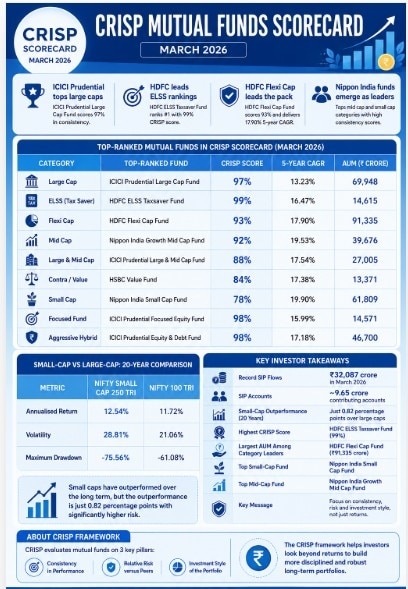



 Despite taking significantly higher risk, small caps outperformed large caps by just 0.82 percentage points annually over the past 20 years, according to the CRISP Mutual Funds Scorecard 2026.
India's mutual fund industry continues to witness strong investor participation despite market volatility, and the latest CRISP Mutual Funds Scorecard from Share.Market (PhonePe Wealth) has identified several category leaders based on performance consistency, risk management and investment style analysis.
According to the March 2026 edition of the report, ICICI Prudential Large Cap Fund emerged as the top-ranked large-cap fund, while HDFC ELSS Taxsaver Fund led the tax-saving category. In the Flexi Cap segment, HDFC Flexi Cap Fund secured the highest score, while Nippon India funds emerged as leaders across key market-cap categories, including mid-cap and small-cap funds.

 From chips to fabs: Ashwini Vaishnaw explains how India is building its semiconductor ecosystem
 JSW MG Motor launches India’s first plug-in hybrid Hector Tomahawk PHEV at Rs 25.69 lakh
 Dubai airport passenger traffic plunges 31% in first half as Iran war disrupts Gulf travel
 GLP-1 market may be smaller than expected, says Lupin; plans next wave of weight-loss drugs
 Waaree, Premier, Vikram Solar, Emmvee: Check targets & upside potential for India's solar stocks
 Nirmala Sitharaman: India’s Banks In Best Health, Global Interest Rising In GIFT City
 PSU Banks Outlook: Why SBI, Canara Bank & Indian Bank Remain Top Picks; HDFC Bank Faces Pressure
 HDFC Bank Mis-Selling Row Escalates As Dubai Investors Plan PMO, RBI Complaints | HDFC Bank Shares
 U.S. Pauses Visa Appointments Worldwide: What It Means For Indian Students And Professionals
 Mumbai Transport Gets Rs 134 Crore Facility Management Boost
 Waaree, Premier, Vikram Solar, Emmvee: Check targets & upside potential for India's solar stocks
 Mazagon Dock shares: Defence stock may regain momentum, says Rachit Khandelwal
 Adani Enterprises, Adani Green shares: Buy, hold or sell these two Adani stocks?
 Solar PV maker Avaada Electro filed DRHP with SEBI to launch Rs 7,600 crore IPO; check key details
 DCB Bank shares climb 6% on report of PE capital infusion talks
 Will your breakfast get costlier? Egg prices jump 40% as ethanol pushes maize to ₹26,500Nirmala Sitharaman: India’s Banks In Best Health, Global Interest Rising In GIFT CityPSU Banks Outlook: Why SBI, Canara Bank & Indian Bank Remain Top Picks; HDFC Bank Faces PressureHDFC Bank Mis-Selling Row Escalates As Dubai Investors Plan PMO, RBI Complaints | HDFC Bank SharesU.S. Pauses Visa Appointments Worldwide: What It Means For Indian Students And Professionals


