











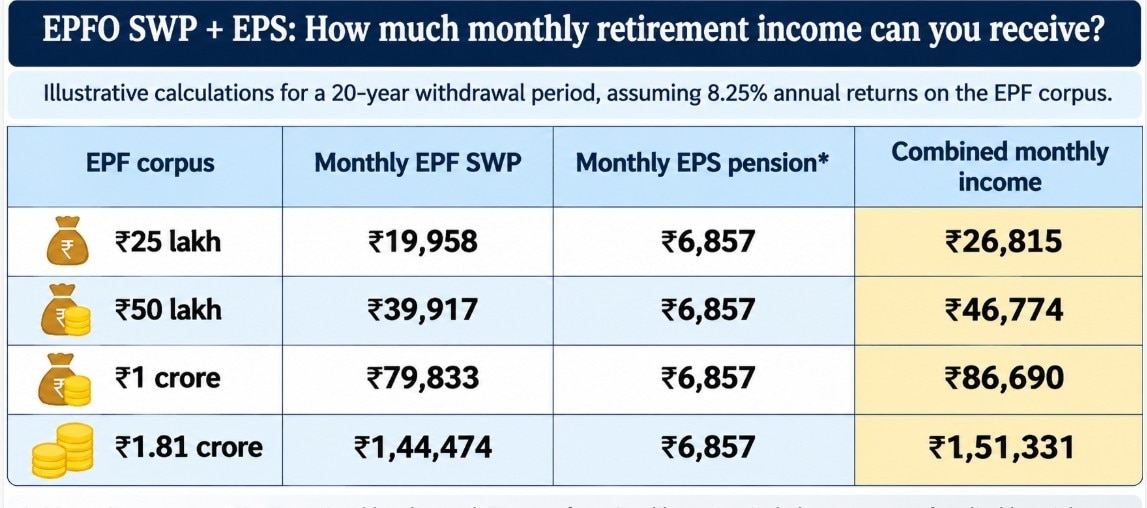



 Unlike EPS pension payments, EPF withdrawals would come from accumulated savings and could eventually exhaust the corpus.
Retirement planning for millions of salaried employees could become more flexible following the Employees' Provident Fund Organisation's (EPFO) decision to introduce a systematic withdrawal plan for retiring subscribers.
The proposal, approved at the 240th Central Board of Trustees (CBT) meeting, would allow eligible members to withdraw accumulated EPF savings periodically instead of taking the entire corpus as a lump sum.

 SEBI proposes FPI rule relaxation after ₹5.61 lakh crore outflows: Will foreign investors return?
 RBI simplifies foreign payment rules for freelancers: Who is exempt from export declaration filing?
 Air India losses top Rs 22,000 crore in FY26 as fuel costs, Pakistan airspace curbs hit turnaround
 Core sector growth hits 13-month high of 10.9% in October: Is India's industrial recovery gaining momentum?
 Is the 60:40 investment portfolio losing relevance? Amundi suggests a new strategy for 2027
 Weekend OTT Releases: Dhindora 2, The Vvaan, Campus Diaries 2 & The Odyssey
 TVS Succession Battle: Kapil Sibal Vs Manu Singhvi On Lakshmi Venu's Claim To Family Wealth
 TVS Family Dispute: Abhishek Manu Singhvi Responds to Claims of an Unequal Wealth Division
 SEBI Chief Tuhin Kanta Pandey On FPI Reforms | 5-Day Onboarding, Easier KYC For Foreign Investors
 TVS Succession Battle: Why Is the 2017 Family Settlement Being Challenged Now? Singhvi Explains
 SEBI proposes FPI rule relaxation after ₹5.61 lakh crore outflows: Will foreign investors return?
 Anthropic shares plunge after record IPO: Is the global AI investment boom losing momentum?
 Anthropic shares tumble after record $107 billion IPO as AI valuation concerns rattle global markets: Report
 Capital markets must serve real economy, not the other way around: CEA
 BT Closing Bell: Markets extend gains as Sensex jumps 898 points, Nifty reclaims 25,800
 From traditional kothis to luxury apartments: Why Ludhiana's homebuyers are embracing high-rise livingRBI simplifies foreign payment rules for freelancers: Who is exempt from export declaration filing?
 Microsoft to help 3,000 Indian MSMEs adopt AI in 60 days: Can technology transform small businesses?SEBI proposes FPI rule relaxation after ₹5.61 lakh crore outflows: Will foreign investors return?Is the 60:40 investment portfolio losing relevance? Amundi suggests a new strategy for 2027


