On May 16, the two companies announced a Memorandum of Understanding (MoU) to support Tata Electronics’ upcoming 300 mm semiconductor fabrication plant in Dholera, Gujarat, India’s first commercial wafer fab. The planned facility involves an investment of $11 billion and will manufacture chips across applications, including automotive, mobile devices and artificial intelligence (AI).
The partnership is important not just because ASML’s chipmaking machines are critical to semiconductor production globally, but also because it highlights a larger global push to build secure chip supply chains outside China and Taiwan.
“India currently holds a unique yet asymmetric position within the global semiconductor value chain, with significant strength in design and engineering but still limited manufacturing maturity,” said Ashwath Rao, industry analyst and researcher at Counterpoint Research.
Rao said India has built deep capabilities in semiconductor design, Very Large Scale Integration (VLSI) engineering, AI and automotive chip development, but still lacks a mature manufacturing ecosystem across wafers, materials and fabrication infrastructure.
Must read: Why Japan's semiconductor consolidation is a wake-up call for India's chip ambitions
“Although India has achieved early progress in assembly and testing, its domestic semiconductor ecosystem across materials, equipment, wafers and large-scale leading-edge fabrication remains underdeveloped,” he said.
Why the ASML partnership matters
ASML is one of the most strategically important companies in the global semiconductor industry. Its lithography systems are essential for producing advanced chips and access to these tools has become increasingly sensitive amid US-China technology restrictions.
“Lithography is the heart of semiconductor manufacturing and without these tools there is no commercial-scale fab, yield consistency becomes impossible and process scaling becomes extremely difficult,” Rao said.
According to him, the Tata-ASML partnership gives India a “scalable lithography foundation” that could eventually support manufacturing beyond 28nm through advanced immersion deep ultraviolet (DUV) and multi-patterning capabilities.
The partnership also has implications beyond wafer fabrication. Rao noted that Tata’s OSAT and advanced packaging roadmap could increasingly benefit from ASML’s metrology and lithography optimisation capabilities as the industry moves toward chiplets, wafer-level packaging and hybrid bonding integration.
Must read: How Indian conglomerates are shifting India’s semiconductor playbook
Kathir Thandavarayan, Partner at Deloitte India, said semiconductor manufacturing cannot succeed through fabs alone.
“Building a globally competitive semiconductor ecosystem requires development of an end-to-end value chain that includes close collaboration with equipment manufacturers and material suppliers,” he said.
Thandavarayan added that securing access to lithography systems early is critical because of their “extremely high capital cost, technological complexity, and long procurement lead times.”
“Beyond equipment access, the collaboration can accelerate the development of local engineering talent, operational expertise, and process know-how, all of which are fundamental for India’s long-term ambition to become a credible semiconductor manufacturing hub integrated into the global supply chain,” he said.
India’s mature-node strategy
Tata Electronics is developing the Dholera fab with technology access ranging from 28nm to 110nm through its partnership with Taiwan’s PSMC. Industry experts believe this focus on mature-node manufacturing is the right entry point for India rather than immediately chasing cutting-edge nodes.
“India is unlikely to replicate the fab-first model or the scale-driven approach,” Rao said, arguing that the country should instead pursue a “design-led manufacturing evolution.”
Must read: Micron’s Sanand plant puts India on the chip map, now the hard part begins for the country
He said India’s strongest near-term opportunity lies in mature-node chips used in automotive, telecom, industrial and power applications, alongside advanced packaging and OSAT capabilities.
“Advanced Packaging is again a strategic sweet spot and India’s best manufacturing entry point as it offers lower capex than leading-edge fabs, critical for AI era chiplets and High Bandwidth Memory (HBM) integration,” Rao said.
Deloitte’s Thandavarayan echoed that view, saying India’s initial semiconductor investments are expected to account for only around 1% of global manufacturing capacity in the near term.
“The country’s initial strategy was to focus on mature and proven technology nodes,” he said, adding that mature-node chips continue to see strong demand across automotive electronics, industrial systems and power management devices.
He said India’s broader strategy is to first build foundational manufacturing capability and integrate into global supply chains before scaling toward more advanced nodes.
The bigger challenge
While the Dholera fab has become one of India’s flagship semiconductor projects, analysts say building the facility is only the first step. The harder challenge lies in achieving global manufacturing standards, stable yields and operational excellence.
“The Tata-ASML partnership is less about one fab and more about building India’s semiconductor operating system,” Rao said.
Must read: Pax Silica membership positions India at the heart of a new US-led tech order
“The real value is not just the lithography machines, it is the transfer of manufacturing discipline, yield-learning capability, ecosystem credibility, and global customer confidence.”
India still faces major gaps in semiconductor talent and project execution capability.
“India presently lacks a sufficiently large pool of professionals with deep semiconductor domain expertise required to operate world-class semiconductor manufacturing facilities,” Thandavarayan said.
He added that India also has limited experience in constructing highly specialised semiconductor cleanroom facilities that require stringent contamination control and precision engineering standards.
Still, industry observers believe India now has a credible opportunity to become part of the global semiconductor manufacturing map if policy support, infrastructure development and ecosystem investments continue over the next decade.
“India has the potential to emerge as a major semiconductor manufacturing destination within the next decade,” Thandavarayan said.



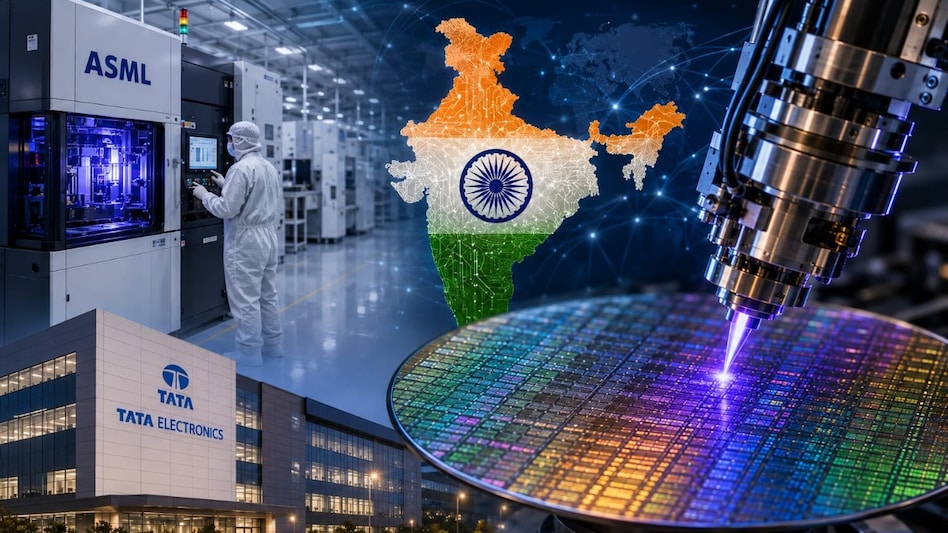 The partnership is important not just because ASML’s chipmaking machines are critical to semiconductor production globally, but also because it highlights a larger global push to build secure chip supply chains outside China and Taiwan.
 Tata Trusts asks Tata Sons to explore options other than listing, says ‘Tata Model has to be saved’
 Tata Trusts proposes ₹25,000 crore plan for SP Group, says Tata Sons listing is not an option
 'RBI letter does not mention listing': Noel Tata seeks full briefing on Tata Sons-RBI talks
 'We cannot put the cart before...': Noel Tata's argument against N Chandrasekaran's reappointment
 Tata Trusts opposes N Chandrasekaran reappointment, says board resolution is ‘legal nullity’
 How India Changed In 12 Years: PM Modi’s Journey From Economic Reforms To Viksit Bharat
 Modi @76: From Twitter To Instagram, How His Digital Outreach Has Evolved
 Stock Picks To Watch: Shibani Kurian Reveals Kotak AMC’s Market Bets
 Gold ETF vs Physical Gold: Know the Tax Rules, Charges and Key Differences
  PPF vs NPS: Tax Benefits, Returns and Lock-in Period Explained for Retirement Planning
 Hero Motors IPO subscribed 3.37 times on Day 2; retail portion subscribed over 5 times
 NSE IPO: India's largest exchange gets 43% subscription on Day 1; NIIs, retail see strong demand
 Rentomojo shares settle maiden trade nearly 32% above IPO price; what should investors do now?
 Sensex slips, Nifty settles higher; Tata stocks gain after N Chandrasekaran reappointment
 Cochin Shipyard, KRBL, RITES, Ramky Infrastructure among stocks to turn ex-dividend on September 18
 TVS Motor to increase monthly EV capacity to over 50,000 units as sales boom
 'Foreign investors want only returns': Noel Tata explains why he opposes listing Tata Sons
 Want EPFO Updates On WhatsApp? Here’s How To Follow The Official Channel In Just A Few Steps












