











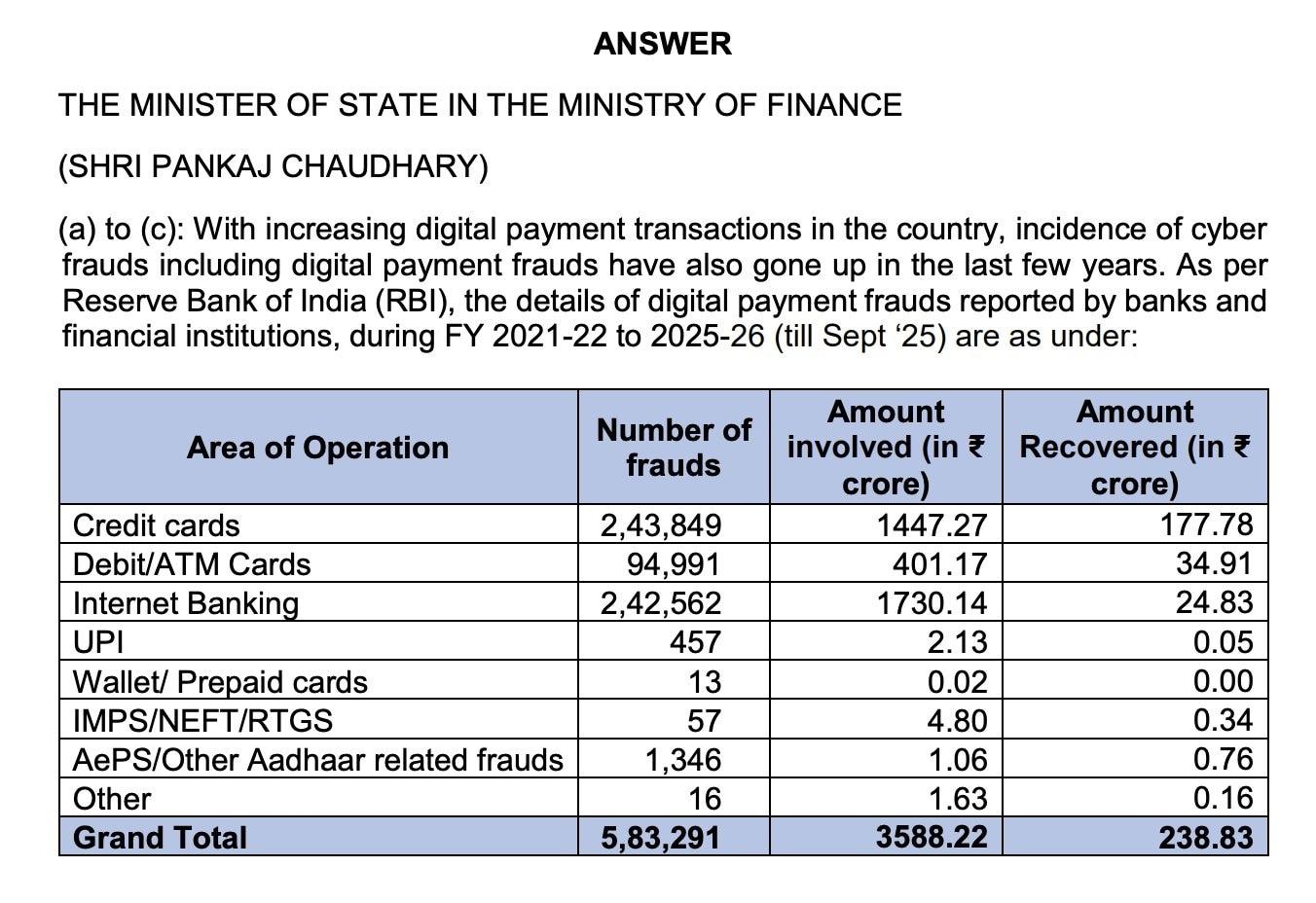



 Internet banking accounted for the largest amount involved in reported digital payment frauds.
Recovering money lost to digital payment fraud remains a significant challenge for bank customers, with government data showing that less than 7% of the amount involved in reported frauds has been recovered. Internet banking recorded a particularly low recovery rate, followed by UPI among major payment channels.
According to Ministry of Finance data, based on figures provided by the Reserve Bank of India (RBI), banks and financial institutions reported 5,83,291 digital payment frauds involving Rs 3,588.22 crore between FY2021-22 and September 2025. However, only Rs 238.83 crore was recovered, translating into an overall recovery rate of 6.66%.

 Why AI literacy is now the CEO’s most critical job
 Jensen Huang disclosed additional affairs before he was reinstated as Nvidia CEO: Report
 5 times the tax, impounding of vehicle: MCD has a new plan for those evading toll
 Nifty 500 companies log strongest earnings growth in 12 quarters; PAT jumps 32% in Q2: MOFSL
 Tata Sons postpones crucial Nov 26 board meeting to Nov 30
 Gold Purity Scare: Rhenium Powder Contamination Raises Alarm, Jewellers Seek BIS Intervention
 Which Sectors And Stocks Can Drive Market Returns? Rahul Arora Shares His Top Investment Bets
 Silver Price Crash: How Much Further Can Prices Fall? Expert Flags ₹1.40 Lakh As Key Support
 Gold vs Silver: Which Metal Will Outperform? Expert Explains Allocation Strategy For Investors
 PM 0.1 Is Entering Your Blood Stream, Increasing Chances Of Brain Haemorrhage & Other Diseases

 IRCTC shares down 65% from record high, here's what brokerages say
 Nifty Bank tumbles 2,600 pts from record high, more losses likely?Nifty 500 companies log strongest earnings growth in 12 quarters; PAT jumps 32% in Q2: MOFSL
 As bears make a comeback, FIIs still in festive mood for tenth day; infuse Rs 5,672 crore
 NVIDIA pips Microsoft, Google in market cap after Jensen Huang's return as CEO
 Punjab elections 2027: BJP, Akali Dal revive alliance after six years; SAD to be the senior partnerGold Purity Scare: Rhenium Powder Contamination Raises Alarm, Jewellers Seek BIS Intervention
 AI-native cybersecurity: How artificial intelligence is transforming threat detection and response
 ‘How can this happen?’: Passenger gets berth 54 in AC 2-tier coach with only 52 berths
 India Inc's profits surge 88%, but factory jobs rise just 31% in four years: What explains the gap?


