











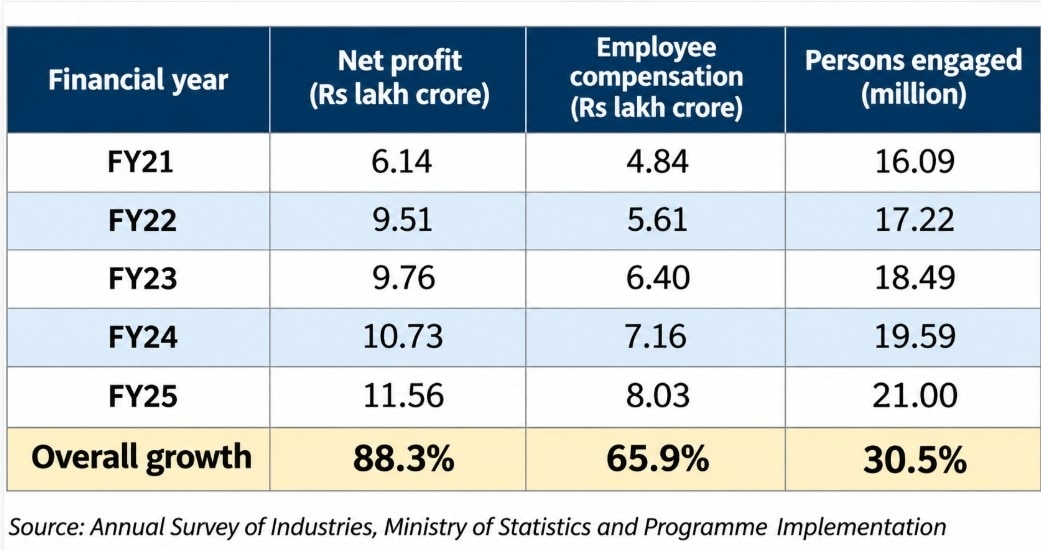



 Average annual emoluments per person engaged in registered manufacturing rose from Rs 3.01 lakh in FY21 to Rs 3.82 lakh in FY25.
Corporate profitability in India's registered manufacturing sector has grown significantly faster than employment and employee compensation over the past four years, lending some support to Prime Minister Narendra Modi's recent remarks on the need for businesses to create more jobs and improve wages.
According to government data cited by Reuters, net profits at India's registered factories increased nearly 88% from Rs 6.14 lakh crore in FY21 to Rs 11.56 lakh crore in FY25. During the same period, total employee compensation rose nearly 66%, while the number of persons engaged increased just 31%.

 Why AI literacy is now the CEO’s most critical job
 Jensen Huang disclosed additional affairs before he was reinstated as Nvidia CEO: Report
 5 times the tax, impounding of vehicle: MCD has a new plan for those evading toll
 Nifty 500 companies log strongest earnings growth in 12 quarters; PAT jumps 32% in Q2: MOFSL
 Tata Sons postpones crucial Nov 26 board meeting to Nov 30
 Which Sectors And Stocks Can Drive Market Returns? Rahul Arora Shares His Top Investment Bets
 Silver Price Crash: How Much Further Can Prices Fall? Expert Flags ₹1.40 Lakh As Key Support
 Gold vs Silver: Which Metal Will Outperform? Expert Explains Allocation Strategy For Investors
 PM 0.1 Is Entering Your Blood Stream, Increasing Chances Of Brain Haemorrhage & Other Diseases
 Banking & Metal Stocks Drag Markets: Where Should Investors Look Now? | Chandan Taparia

 IRCTC shares down 65% from record high, here's what brokerages say
 Nifty Bank tumbles 2,600 pts from record high, more losses likely?Nifty 500 companies log strongest earnings growth in 12 quarters; PAT jumps 32% in Q2: MOFSL
 As bears make a comeback, FIIs still in festive mood for tenth day; infuse Rs 5,672 crore
 NVIDIA pips Microsoft, Google in market cap after Jensen Huang's return as CEO IRCTC shares down 65% from record high, here's what brokerages say
 Brahmastra 2 could be ‘even more Indian’: Ayan Mukerji on Ranbir Kapoor’s sequel
 Why Investors Should Consider a Multi-Cap Approach NowWhich Sectors And Stocks Can Drive Market Returns? Rahul Arora Shares His Top Investment Bets
 IRM India Affiliate and ICICI Lombard Launch 4th India Risk Report, Highlighting Convergence of RiskForces


