
Search
Advertisement
Hybrid SIFs control 70% of industry assets: Why investors are looking beyond pure equity strategies

Hybrid SIFs control 70% of industry assets: Why investors are looking beyond pure equity strategies

Hybrid strategies are dominating India's emerging Specialised Investment Fund (SIF) industry, accounting for over 70% of total assets despite having fewer schemes than equity-oriented funds. The trend highlights growing interest in investment strategies that combine asset allocation flexibility with hedging opportunities.

Basudha Das
Basudha Das
  • Updated Nov 17, 2026 4:10 AM IST
Hybrid SIFs control 70% of industry assets: Why investors are looking beyond pure equity strategiesHybrid Long-Short Funds generally maintain exposure to both equity and debt, while Active Asset Allocator Long-Short Funds can dynamically shift investments across asset classes.

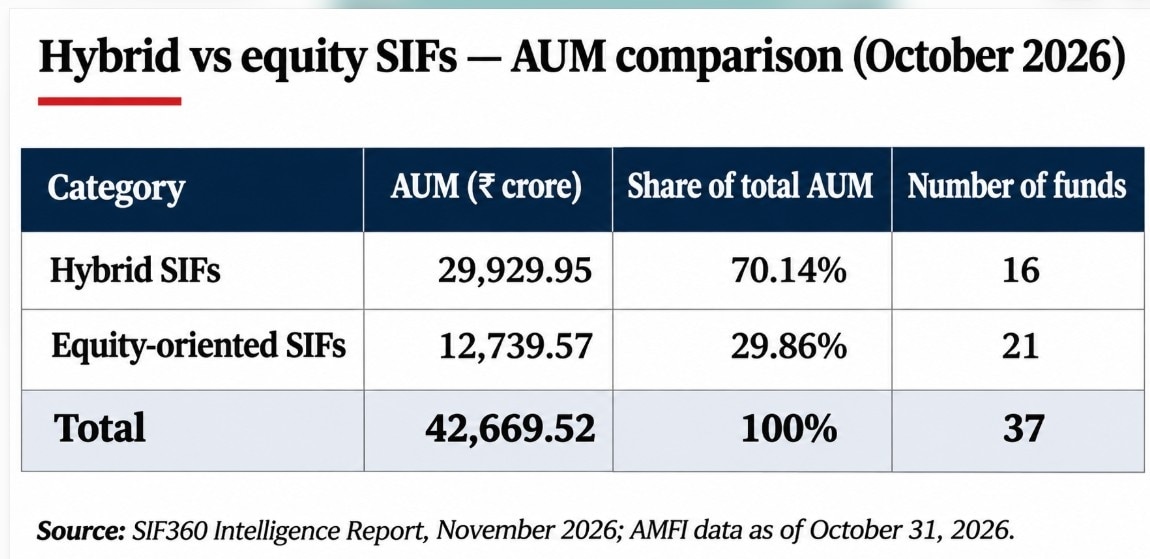
India's Specialised Investment Fund (SIF) industry is witnessing a clear preference for hybrid investment strategies, with these funds managing ₹29,929.95 crore, or 70.14% of total industry assets, as of October 31, 2026.

According to the November 2026 SIF360 Intelligence Report, equity-oriented strategies account for ₹12,739.57 crore, representing 29.86% of industry assets.

Advertisement

Interestingly, equity-oriented SIFs comprise 21 schemes, compared with 16 hybrid schemes, indicating that hybrid funds have attracted substantially larger asset allocations despite offering fewer products.

Why are hybrid SIFs attracting more money?

Unlike pure equity strategies, hybrid SIFs can invest across multiple asset classes, including equities, debt instruments and, depending on the strategy, REITs, InvITs and commodity derivatives.

This flexibility allows fund managers to adjust portfolio allocations according to market conditions rather than remaining predominantly invested in equities.

Hybrid Long-Short Funds generally maintain exposure to both equity and debt, while Active Asset Allocator Long-Short Funds can dynamically shift investments across asset classes.

Both strategies may use derivatives to establish limited short positions or hedge certain market risks, subject to regulatory restrictions.

Advertisement

However, hedging does not eliminate losses, and its effectiveness depends on portfolio positioning and market movements.

MUST READ: HDFC's new fund can short stocks up to 25%: Can it make money when markets fall?

Hybrid funds dominate October inflows

Fresh investment data reinforces the dominance of hybrid strategies.

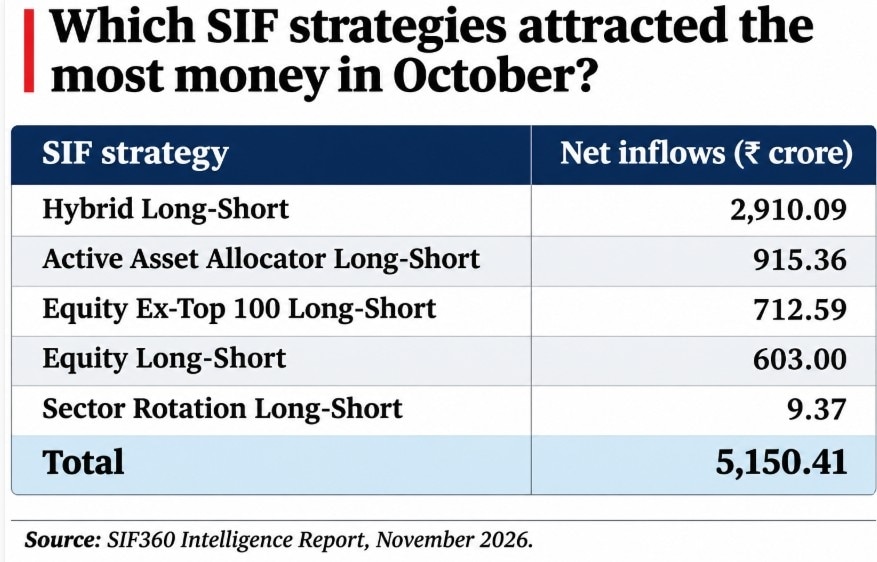
Hybrid Long-Short Funds attracted ₹2,910.09 crore in net inflows during October, accounting for approximately 56.5% of the industry's total monthly net inflows of ₹5,150.41 crore.

Active Asset Allocator Long-Short Funds received another ₹915.36 crore.

Together, these categories accounted for approximately ₹3,825 crore in net inflows, reflecting substantial investor interest in flexible investment approaches.

How did hybrid and equity SIFs perform?

Advertisement

Performance figures show that investment flexibility does not necessarily guarantee superior returns.

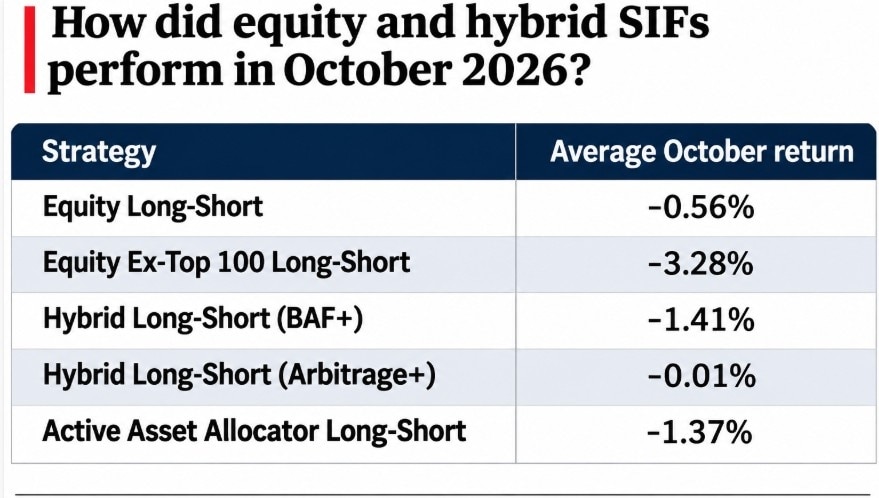
In October, Equity Long-Short Funds recorded an average return of -0.56%, while Equity Ex-Top 100 Long-Short Funds declined by an average 3.28%.

Among hybrid strategies, the Arbitrage+ segment recorded an average return of -0.01%, while the BAF+ segment declined by 1.41%.

Active Asset Allocator strategies also recorded an average decline of 1.37%.

These differences highlight how underlying portfolio strategies influence performance, even within the broader hybrid category.

What should investors consider?

SIFs require a minimum investment of ₹10 lakh and are designed for investors seeking more sophisticated strategies than conventional mutual funds.

ALSO READ: Axis AMC’s SIF entry: What investors should know about the new investment category

Investors should assess asset allocation, derivative exposure, liquidity, expenses and risk levels before investing.

Advertisement

Although hybrid SIFs dominate industry assets, their popularity alone does not establish that they are safer or more suitable than equity-oriented alternatives.

The industry's growth suggests increasing demand for flexible investment products, but long-term performance will determine whether these strategies justify their growing share of investor capital.

ABOUT THE AUTHOR

Basudha Das
Basudha Das

With over 16 years of experience in the newsroom, I am currently covering personal finance, banking, financial services, and insurance sector, bullion and metals, sports, and other trending topics. When not chasing interest rates and new-age investment tools, I like to follow and cover climate change trends and environment-friendly initiatives across the world. When not at work, I spend time learning Bharatnatyam from my guru, and baking from my daughter.

Published on: Nov 17, 2026 4:10 AM IST