











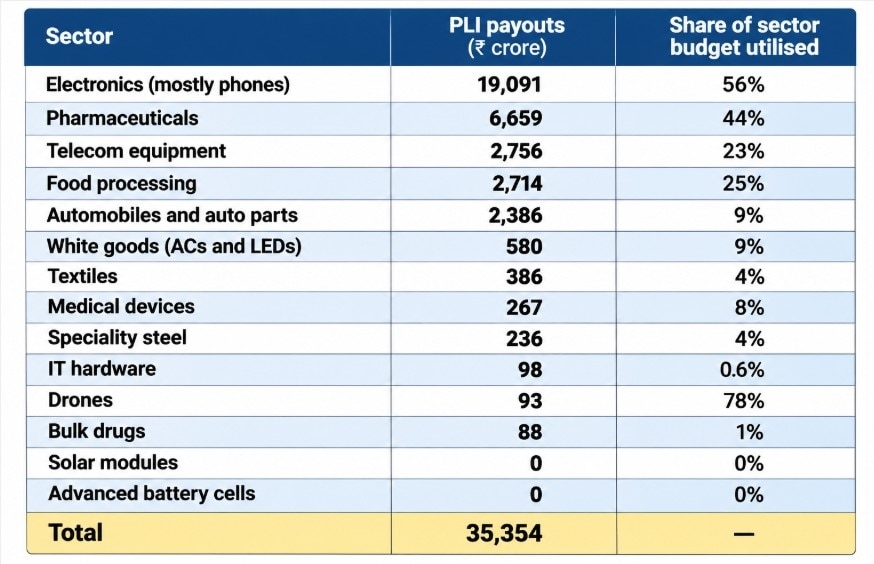



 shorten to 1 line A NITI Aayog–IIM Ahmedabad assessment shows four sectors received ₹31,220 crore, nearly 88% of the ₹35,400 crore PLI payouts.
India's ambitious ₹1.91 lakh crore Production-Linked Incentive (PLI) programme has delivered uneven results, with just four of the 14 schemes accounting for nearly 88% of total incentives disbursed through March 2026. While electronics and pharmaceuticals have emerged as major beneficiaries, sectors such as solar modules and advanced battery cells have yet to receive any payouts.
According to an analysis shared by Markets by Zerodha, citing the November 2026 NITI Aayog–IIM Ahmedabad impact assessment of PLI schemes, approximately ₹35,400 crore has been disbursed so far. Of this, electronics, pharmaceuticals, telecom equipment and food processing together received ₹31,220 crore, highlighting the concentration of incentives among a handful of industries.

 Budget 2027-28: Centre may ease fiscal consolidation, target 4% deficit
 Gold prices are falling. How will it affect your gold loan?
 Budget FY28 may widen PLI schemes to boost sunrise sectors, advanced technology, manufacturing
 Gold took 26 years, silver 31 years to recover from crashes: What investors should learn
 India narrows gap with China: Defence, trade stability lift regional clout in 2026 Asia Power Index
 Banking & Metal Stocks Drag Markets: Where Should Investors Look Now? | Chandan Taparia
 India Records Highest-Ever Festive Auto Sales | EV Sales Surge 53%, PV Sales Decline: FADA
 What’s Hot: Stocks, Gold & Big Money Moves | Daily Markets Show | November 23 | Business Today
 Small Caps Vs Large Caps: Where Is The Bigger Opportunity Now? | Sharad Avasthi
 Tata Sons Board Meet Postponed: Report | Noel Tata Flags Notice Violation, Seeks Board Respons

 Stock market holiday on November 24: Are NSE, BSE closed for Guru Nanak Jayanti?
 Mahanadi Coalfields IPO subscribed 1.52 times on final day; QIBs lead demand
 Stock market: India's weight in MSCI EM rises 400 bps; further increase likely, says Axis Capital
 Dalmia Bharat announces Rs 700-crore buyback; sets maximum price at Rs 1,850 per share
 Tech Mahindra shares end higher after board fixes record date for bonus issue
 BJP agents keeping Nitish Kumar away: Prashant Kishor alleges JD(U) merger plan
 India's trade ambitions need a globally skilled workforce. Are Indian universities preparing graduates for it?
 After 26 Years, Coca-Cola Revives an Iconic Drink!
 Modi-Balen Shah Gift Exchange: Gangajal From Triveni, Rudraksh & Chandan From PashupatinathStock market holiday on November 24: Are NSE, BSE closed for Guru Nanak Jayanti?


