"It didn't take long to realise that the need was everywhere," she told India Today. "The more I saw, the harder it became to answer one simple question: Where could I make the biggest difference?”, she added.
Gojkovic said her experience with local organisations also made her question whether conventional aid was always reaching communities in the way they needed.
"As I spent more time in the sector, I also witnessed challenges such as poor financial accountability and projects that sometimes missed the priorities of the communities themselves," she said.
Don't Miss: US may scrap 60-day job search window: What it means for Indians facing job loss on H-1B visas
"That experience led me to believe that lasting change needed to be transparent, locally driven, and built alongside the people it was intended to serve," she added.
The search that led her to Sagar Island
Her search eventually brought her to Sagar Island, where reaching villages meant crossing a river by boat and timing journeys according to the tides.
"It was very remote, and simply getting there meant crossing a river by boat. Access depended entirely on the tides and the boat schedule, making the journey difficult and unpredictable," she said. "I assume because of that, no other NGO wanted to work there, it was simply too far and too challenging to reach. On top it is very prone to cyclones."
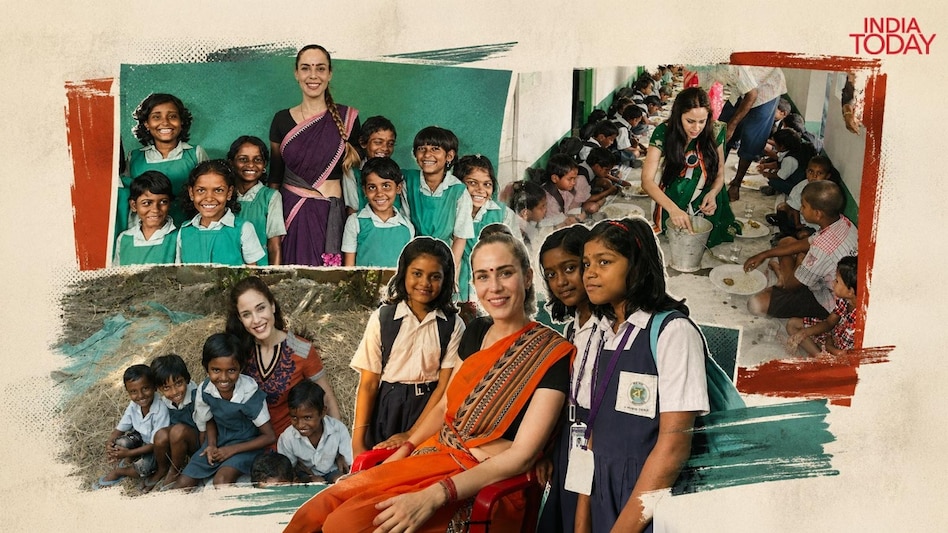
Education emerged as one of the most pressing concerns during her conversations with residents. Government primary schools existed, but according to Gojkovic, teachers often did not turn up, leaving children without regular access to learning.
She eventually founded a primary school in the area. The project, which she had kept largely private in its early stages, became the foundation for her work in the region.
Building a school against the odds
"I kept the India School Project almost entirely to myself because, when I left for India, many people around me discouraged me," she said.
Gojkovic said her family and friends had warned her that the project would not work. She therefore chose not to tell them about the school until its inauguration.
From selecting the colours for the building to buying uniforms and kitchen utensils, she was involved in the school's early preparations. But getting the building ready was only the beginning.
Some parents were initially reluctant to send their children to school because they relied on them to work in the fields.
"The moment that worried me most was when some parents were reluctant to send their children to school because they depended on them to help in the fields," Sandra says. "I genuinely wondered whether the classrooms would stay empty."
Local teachers then went from house to house, collecting children and explaining to their parents why education mattered. Over time, enrolment increased as families began seeing the benefits of regular schooling.
The education programme has since reported a rise in board exam pass rates from 50 per cent to 100 per cent.
Malaria forced her to leave, but not for long
Gojkovic's connection with India, however, was tested early in her journey. She contracted malaria and became seriously ill, forcing her to leave the country for treatment.
"The first time I had to leave India, it wasn't because of my visa, it was because I contracted malaria. I became seriously ill and left just in time before my condition worsened," she said.
She returned to India the day after completing her treatment, despite her doctor's concerns.
From education to child protection
Over the years, the work expanded beyond education. The Women and Children Protection Movement grew out of the issues Gojkovic encountered while working with families in the community.
The initiative conducts school workshops, youth protection groups and community awareness campaigns, while working with local authorities on issues including human trafficking, child marriage and domestic violence.
According to the organisation, 112 youth leaders have been trained through the programme, which has reached roughly 20,000 children, adolescents and adults across 30 villages.
Helping women build independent incomes
A women's empowerment programme was later added, focusing on vocational sewing training, entrepreneurship skills and rights awareness. The aim is to help women develop independent incomes and greater financial and personal confidence.
Gojkovic said the programmes are designed to help communities become less dependent on outside intervention.
"I always remind myself that I'm a guest in India," she says. "I didn't come to replace local knowledge with Western ideas. Before suggesting anything, I try to listen, observe and understand why things are done a certain way."
Why she puts the local team first
She has also deliberately kept the day-to-day management of the project with her local team.
"From the beginning, I never wanted this project to depend on me only and I wanted to empower my local team because they are the ones who live there understand their community far better than I ever could, so I've always trusted my local partners with real responsibility," she said.
"Of course I still oversee budgets and major decisions because every rupee has to be used responsibly. But the day-to-day leadership belongs to the local team, and that's exactly how it should be,” she added.
What Switzerland taught her, and India changed
Living and working in rural Bengal has also changed Gojkovic's understanding of her own upbringing. She says Switzerland taught her structure and discipline, while India taught her patience and resilience.
"I often say that Switzerland shaped how I work, it taught me structure, discipline and organisation. India, on the other hand, shaped who I am. It taught me patience, resilience, acceptance and the ability to let go of the need to control everything."
She said learning to adjust to India's slower pace was one of the biggest changes she had to make.
"I realised that meaningful change cannot be rushed. You can't force trust, relationships or community development, they all take time. Once I stopped trying to make India work like Switzerland and instead learnt to work with India, everything began to flow much more naturally."
The organisation has also faced internal challenges, including cases of dishonesty among staff.
"Like every organisation, we've also had challenges with staff over the years. We discovered a few cases of dishonesty, made difficult decisions, and strengthened our systems," she said.
"Today I'm incredibly proud of our team, they run the project with professionalism and integrity."
The small things that made India home
Gojkovic has remained closely connected to everyday life in the region despite never becoming fluent in Bengali.
"I've always been fortunate to have an incredible local team who translated for me," she said. "Sometimes I even joke that maybe it's better not to understand every single conversation, it probably saves me from overthinking!"
One of her favourite local rituals is stopping for aloo muri in Diamond Harbour on the way to Sagar.
"I absolutely love aloo muri. I always get it when we stop in Diamond Harbour on the way to Sagar, and even today it's one of those little rituals I look forward to," she said. "There's something incredibly simple yet comforting about it, and it always makes me feel at home."
Cyclones changed her perspective
The remote location has also meant repeatedly dealing with cyclones. Parts of the school building have been damaged several times, but Gojkovic said the impact on families is far more difficult to witness.
"Cyclones have damaged parts of our school building several times, but buildings can be repaired," Sandra said.
"What is much harder is seeing families lose everything overnight. Witnessing that changes your perspective. It reminds you how fragile life is, how little we truly own, and that sometimes there are things completely beyond our control,” she added.
Why success means something different now
Gojkovic said her understanding of success has also changed through her years of working with women and children. She grew up associating success with education, a stable career and financial security, but later began placing greater value on meaningful relationships and being useful to others.
Her work in India has also led to misconceptions about her intentions. She said she has sometimes been mistaken for a missionary, but rejects that description.
"My purpose has never been to change anyone's faith. I simply serve with love. Living in India has given me a deep respect for Santana Dharma and its spiritual wisdom," she said.
For Gojkovic, the most meaningful outcome of her work is not recognition for the projects she has built, but seeing children develop ambitions of their own.
She said hearing children speak about wanting to become teachers, doctors, artists or pursue other careers is what makes her happiest. The goal, she believes, is for education to become an ordinary part of their lives rather than something they associate with an outsider who came to help them.
After 15 years, Gojkovic continues to live and work in the region. Her approach remains centred on listening to communities, strengthening local leadership and building programmes that can continue without depending entirely on her.
The school itself reflects that philosophy. She deliberately chose not to name it after herself, preferring that the focus remain on the children and the community rather than on the person who started it.


 Gojkovic has remained closely connected to everyday life in the region despite never becoming fluent in Bengali.
 20 Asia-Pacific stocks with up to 145% upside: Full ‘Going For Glory’ list, no Indian stock included
 Govt won't step into Singapore Airlines' Air India call, says Singapore minister
  India’s energy lifeline runs through the Indian Ocean: Why this maritime corridor matters
 Tax filing 2026: Missed crypto income in ITR? Why investors could receive an Income Tax notice
 CNG, hybrids and EVs reshape India's car market: What August sales reveal
 Home Loans & Insurance: How Couples Can Structure Them For Tax Efficiency
 Money & Marriage: How Couples Can Divide Household Expenses, Track Spending And Stay On Budget
 Parag Parikh Flexi Cap Fund Underperformance: Is Fund Size Becoming A Major Challenge For Investors?
 Midcap, Smallcap Funds: Strong Profit Growth Could Keep Investor Flows Robust, But Valuations Matter
 Travel Insurance Guide: Where To Buy, How Much Cover You Need & When To Get It
 Tata Technologies: Former CEO Patrick McGoldrick sells shares worth nearly Rs 165 crore
 Tata Power stock: Choice Broking expects recovery, assigns two price targets
  IPO rush next week: 11 issues eye to raise Rs 7,055 crore; 6 IPOs to open on same day, check details
 600% dividend stock: Check dividend per share, record date, payment date and other key details
 Petrol, diesel prices today, September 6: Check latest rates in Delhi, Mumbai, Chennai, Kolkata & more
 Corporate FDs: Muthoot offers 8.95%, Shriram 7.5%; what investors should know before investing
 Quote of the Day by Azim Premji: ‘Excellence endures and sustains. It goes beyond motivation into the realms of inspiration’












