The 2026 edition will be the first World Cup to feature 48 teams, up from 32 in previous tournaments, reflecting FIFA's push to broaden global participation. The expanded competition will include a record 104 matches played across 16 host cities over 39 days, making it the largest World Cup ever staged.
MUST READ | FIFA World Cup 2026 broadcast guide: Which TV channels to watch on in India, match timings
According to Bank of America (BofA) Global Research, the tournament is expected to attract approximately 6.5 million spectators, setting new benchmarks for attendance and fan engagement. Four nations — Curaçao, Cabo Verde, Jordan, and Uzbekistan — are set to make their World Cup debuts, highlighting the increasingly global nature of the competition.
Record-breaking number of fans
The tournament's audience reach is expected to be unprecedented. FIFA estimates that more than six billion people, nearly three-quarters of the world's population, will engage with the event through television broadcasts, streaming platforms, digital channels, and social media.
That would surpass the reach of the 2022 FIFA World Cup in Qatar, which engaged around five billion people globally. The final between Argentina and France alone attracted an estimated 1.5 billion viewers, making it the most-watched sporting match in history.
DON'T MISS | Why India has never played in the FIFA World Cup: The story behind a 75-year wait
BofA analysts believe the 2026 final could account for nearly 7% of global internet traffic on match day, underscoring football's unmatched ability to capture worldwide attention.
$40.9 billion boost
The economic impact of the tournament is expected to be equally impressive. A joint study by FIFA and the World Trade Organization (WTO) estimates that the World Cup could contribute $40.9 billion (about ₹3.90 lakh crore) to global GDP and support more than 824,000 jobs worldwide.
The benefits are expected to be felt across a wide range of sectors, including tourism, hospitality, transportation, retail, food services, entertainment, and real estate. Millions of fans travelling across North America are expected to drive spending on accommodation, dining, local transportation, and leisure activities.
Advantage US
Among the three host nations, the United States is projected to capture the largest share of the economic gains.
The FIFA-WTO study estimates that the tournament could add approximately $17.2 billion (around ₹1.64 lakh crore) to US GDP, generate $10.2 billion (about ₹97,000 crore) in labor income, and create nearly 185,000 jobs. The influx of international visitors is expected to provide a significant boost to local businesses and regional economies across host cities.
Brands and advertisers
The World Cup's unparalleled global reach has made it one of the most valuable marketing platforms in the world.
Global advertisers are expected to spend around $10.5 billion to connect with audiences during the tournament — nearly double the $5.7 billion spent across the entire 2025-26 NFL season. For multinational brands, the event offers a rare opportunity to engage billions of consumers simultaneously across continents and cultures.
Record revenue
FIFA itself is expected to emerge as one of the biggest winners from the tournament. The governing body projects a record $8.9 billion in revenue from broadcasting rights, sponsorship agreements, ticket sales, licensing deals, and hospitality packages.
DO CHECKOUT | Cristiano Ronaldo tops highest-paid players at FIFA World Cup 2026; Messi second
Reflecting the tournament's commercial appeal, FIFA has already sold all of its top-tier sponsorship packages well ahead of kickoff, signaling strong demand from global corporations eager to associate with the event.
Not just a football tournament
Beyond the matches themselves, the 2026 FIFA World Cup represents a convergence of sport, business, technology, and culture on an unprecedented scale. From record-breaking audiences and billions of dollars in economic activity to expanded global participation and booming commercial revenues, the tournament is set to become far more than a sporting competition.
With six billion expected viewers, 48 competing nations, 104 matches, and tens of billions of dollars in economic impact, FIFA World Cup 2026 is poised to redefine what a global sporting event can achieve.













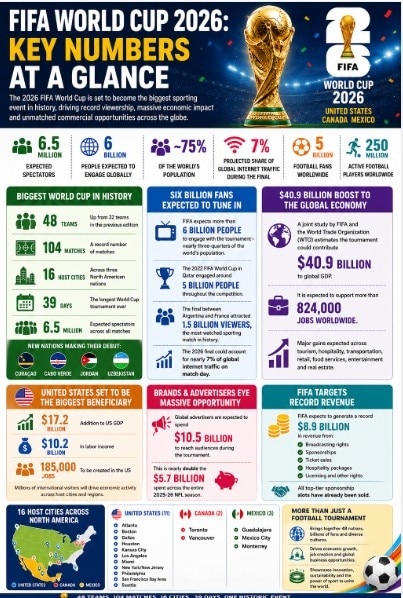



 A joint study by FIFA and WTO estimates that the World Cup could contribute $40.9 billion (about ₹3.90 lakh crore) to global GDP and support more than 824,000 jobs worldwide.
 Tata Trusts propose merger of two Tata units with Tata Sons to avoid listing
 Air India CEO-designate Tewolde lays out 5 priorities, puts safety and reliability first
 Nifty set for worst returns in 15 years, analysts weigh in
  India's industrial output hits 8% growth in August, manufacturing up 9%
 ITR filing deadline for corporates extended to November 21
 Crude Oil Next Big Commodity Bet? | Strait Of Hormuz Crisis | Commodity Outlook
 Nifty Falls: 22,500-22,300 Next? Expert Warns Against Bottom Fishing Amid Sharp Sell-Off
 Meta Muse AI & Smart Glasses, iPhone 18 Pro Max In-Depth Review & Easy iOS Data Transfer | Tech Today
 Silver Slips Below 200 DMA: Why This Crash Is A Golden Buying Opportunity | Navneet Damani
 Gold Falls $1,500 From Peak: Smart Accumulation Or Risky Bet? | Anuj Gupta
 BSE stock may test Rs 3,000 mark, says analyst; stays positive for long term
  Why HDFC Bank, TVS Motor shares are top picks amid ongoing correction
  Tata Steel shares lag peers over three months; is European business weakness priced in?
 YES Bank, BOI, BoM, Union Bank, PNB, RBL Bank: Why bank stocks fell today
 Tata makes its EVs cheaper to buy upfront, under BaaS scheme
 Cleartrip checks in for a holiday-powered growth trip


