















 One should remember that interest earned on FDs is treated as "Income from Other Sources" under income tax rules and is added to a depositor’s total annual income.
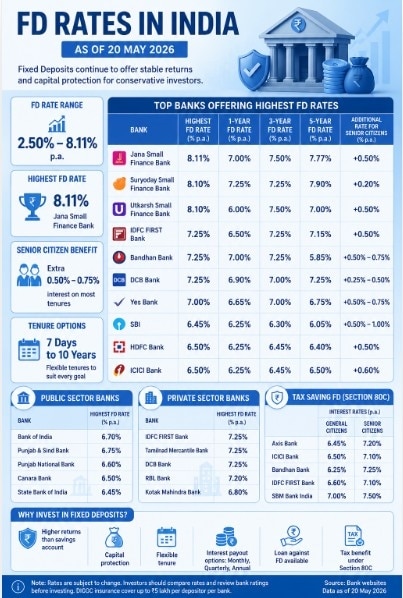
Fixed deposits (FDs) continue to remain a preferred investment avenue for conservative investors seeking stable returns and capital protection amid ongoing market volatility. While equity markets fluctuate, FDs offer predictable returns and are widely used for emergency funds, retirement planning, and short-term financial goals.
As of May 20, 2026, FD interest rates across scheduled banks range between 2.50% and 8.11% annually, depending on tenure and institution type. Small finance banks currently dominate the higher-yield segment, while public and private sector lenders continue to offer competitive rates for mainstream depositors.

 ‘Intellectual poseurs peddling rancorous story’: SBI Ecowrap defends 7.8% GDP growth
 Adani Power, Adani Enterprises, Adani Ports rise up to 70% from 52-week lows; price targets and more
  'Vietnam revised GDP by 25% in 2019': Economist explains why last year's estimate changed
 Japan Inc is betting on India’s wealthy: Why MUFG, Mizuho, Daiwa and SMBC are buying into wealth managers
 RIL share price: Stock in focus on Rs 12,500 crore bond sale report, Jio IPO update
 Non-Local Electric Bus Software Is A National Security Risk, Warns Eka Mobility Chairman Sudhir Mehta
 Mounjaro Sales Surge 502%: Why GLP-1 Drugs Are Taking Over India’s Pharma Market
 Auto Stocks Outlook: Why Investors Should Be Cautious Despite New Model Launches And Strong Demand
 U.S.-Iran War, Elevated Crude Hit Indian Stocks: Can Nifty Reverse Its Downward Trajectory Now?
 Crude Oil, Gold & Silver: What’s The Next Big Move? | Kunal Shah
 Symphony shares: 13% rally in the beaten down stock today, here's why
 Deepa Jewellers made a strong stock market debut; shares list at 25% premium
 TCS shares: JM Financial meets management; here's what it says
 Prasol Chemicals IPO opens today: Should you apply? Check price band, fresh GMP, reviews & more
 Suzlon bags 200 MW wind energy order from Ayana Renewable Power; details here
 Xiaomi's new passport-style foldable is answer to Apple’s iPhone Ultra: All you need to knowSymphony shares: 13% rally in the beaten down stock today, here's whyDeepa Jewellers made a strong stock market debut; shares list at 25% premiumTCS shares: JM Financial meets management; here's what it says
 Over 2,800 kg of unsafe paneer, khoya, butter destroyed in Delhi ahead of festive season


