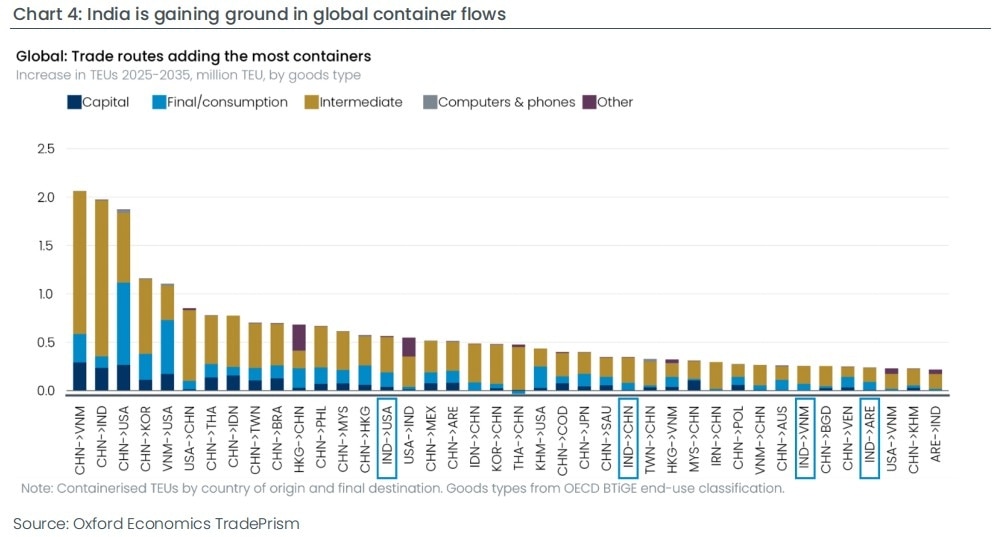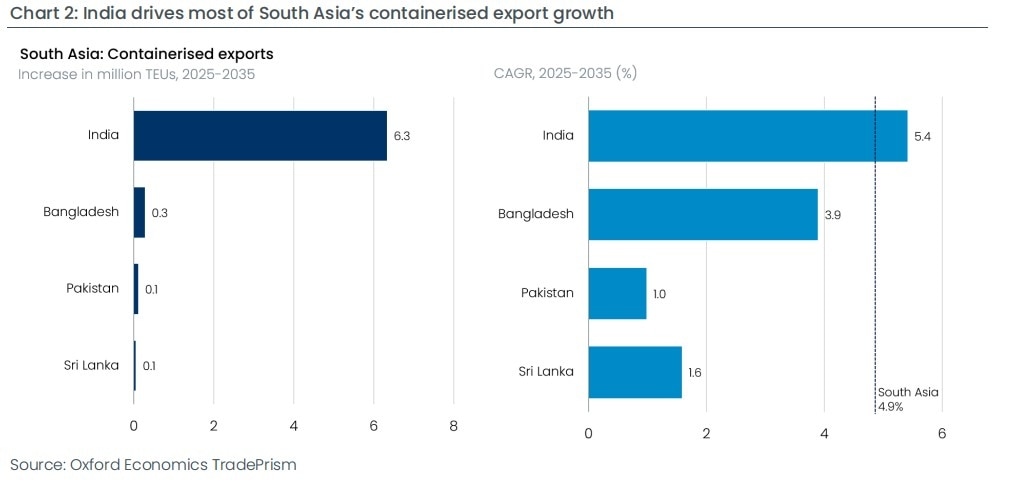



 India is expected to account for more than 90% of the region's additional export containers during this period.
India is poised to dominate South Asia's containerised export growth over the next decade, potentially strengthening its position as a regional manufacturing and trading hub, according to a November 19 report by Oxford Economics.
The report, titled Traditional Industries Power South Asia's Containerised Trade, forecasts India's containerised exports growing 5.4% annually between 2025 and 2035, compared with South Asia's overall growth rate of 4.9%.

 EPFO approves systematic withdrawal plan (SWP): Retirees can receive monthly payouts while earning interest -- details here
 Don't take 140 crore Indians for granted! PM Modi's stern warning to India Inc over quality of products
 New cars need PUC checks only once every three years; BS-IV vehicles every six months
 Where are the jobs and higher wages? PM Modi questions India Inc over massive corporate tax cuts
 BT Closing Bell: Sensex surges 990 points; Nifty reclaims 25,500 for first time since February 26
 What Is Siemens S3 Passenger? The Technology Transforming Railway Ticketing & Reservations
 'Daughter Is Not A Guest': Kapil Sibal On TVS Family Dispute & Equal Inheritance Rights
 Gold At 14-Month Low! Is This The Right Time To Buy? | Surendra Mehta, IBJA
 Market Commentary: Deven Choksey On Market Trends, Nifty Levels & Buying Opportunities
 What Is Siemens DepotFinity? How It Can Transform EV Fleet & Charging Management

 Anthropic's $1.5 trillion valuation surpasses combined m-cap of India's top 10 companies
 Aurionpro Solutions wins Rs 100-crore order for AI-ready data centre in Southern India, check stock reaction
 Poonawalla Fincorp to issue non-convertible debentures worth up to Rs 500 crore
 Punjab National Bank shares close 4% higher as Moody's affirms Baa3 ratings
 ITC shares hit five-month high, reclaim Rs 300 mark; analysts share price targets What Is Siemens S3 Passenger? The Technology Transforming Railway Ticketing & Reservations
 Dwarka Expressway property prices: Will the proposed Yashobhoomi-Gurugram Metro fuel another rally?
 'File your nomination, I'll file mine': Yogi dares Akhilesh to contest from AyodhyaAnthropic's $1.5 trillion valuation surpasses combined m-cap of India's top 10 companies
 Muhammad Yunus’ ancestral home torched as Awami League’s nationwide shutdown begins in Bangladesh