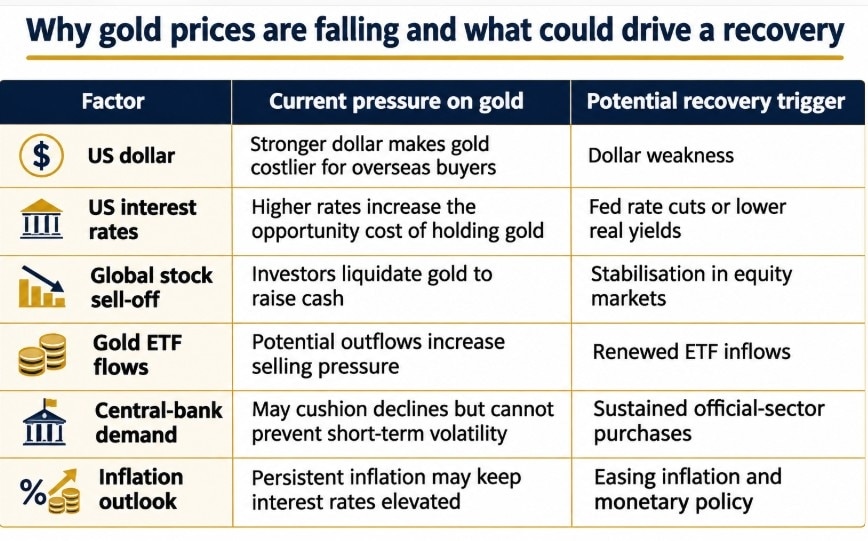



 Gold's recovery will depend on whether the correction is temporary, with monetary policy, institutional demand and market conditions determining its outlook.
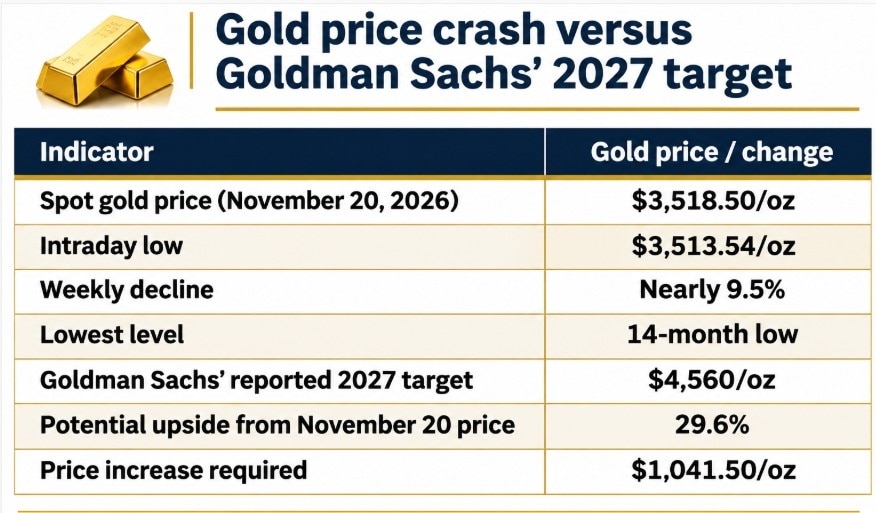
International gold prices extended their losses on Friday, November 20, recording their worst weekly performance in eight months as investors reassessed the outlook for US monetary policy and sought liquidity amid a broader market downturn.
According to Reuters, spot gold declined 2.8% to $3,518.50 per ounce on Friday, after touching $3,513.54, its lowest level since September 2025. US gold futures for December delivery dropped 4.5% to $3,519.10.

 Silver crashes from $121 to $44: How much would a $10,000 investment have lost?
 Bitcoin below $57,000: How 55% slump from record high stacks up against every major crypto winter since 2014
 'Look at India': Trump says US could hit 20% GDP growth if Fed cuts interest rates
 US-China chip war escalates: How new restrictions could reshape the global AI industry
 Vedanta's Anil Agarwal outlines 3-point growth plan after PM Modi flags industry job lag. What he said
 Which Sectors Should Investors Avoid Now? Siddhartha Khemka Flags Key Market Risks
 Pollution-Linked Health Claims Surge 4.3X In Three Years, Working Professionals Among Most Affected
 Persistent Cough, Breathlessness? Doctor Explains Symptoms You Must Never Ignore Amid Pollution
 Which 2 Sectors Could Lead The Next Market Rally? Expert Reveals Top Stock Picks For Investors
 Gold & Silver Crash: What Triggered The Massive Sell-Off?

 SEBI's AI rules: Who pays when an algorithm gives investors the wrong investment advice?
 ITC: Highest monthly gain in over two years, strongly overbought on charts; fresh price targets and more
 GRSE, Coforge, Lloyd Metals, BDL, Tanfac, Sambhav Steel among top 20 stocks with upto 75% upsideBitcoin below $57,000: How 55% slump from record high stacks up against every major crypto winter since 2014
 Nifty's sharp comeback after market correction: What should investors do next as valuations turn attractive?
 Dubai property investment: What can Indians buy with ₹1 crore, ₹2 crore or ₹5 crore in 2026?Which Sectors Should Investors Avoid Now? Siddhartha Khemka Flags Key Market Risks
 Cataracts cause 66% of blindness among older Indians: Why are patients delaying treatment?SEBI's AI rules: Who pays when an algorithm gives investors the wrong investment advice?ITC: Highest monthly gain in over two years, strongly overbought on charts; fresh price targets and more