
Search
Advertisement
US-China chip war escalates: How new restrictions could reshape the global AI industry

US-China chip war escalates: How new restrictions could reshape the global AI industry

The US has tightened restrictions on advanced AI chip exports to five countries, aiming to block China's access to American technology through overseas data centres. Jefferies warns that the move could disrupt global semiconductor supply chains and accelerate China's push for chip self-reliance.

Basudha Das
Basudha Das
  • Updated Nov 21, 2026 2:15 PM IST
US-China chip war escalates: How new restrictions could reshape the global AI industryThe US has tightened AI chip export restrictions to prevent Chinese companies from accessing advanced American technology through overseas data centres.

The US-China chip war has intensified as Washington tightened restrictions on advanced AI chip exports to five countries, seeking to prevent Chinese access through overseas data centres. The move comes amid fresh regulatory pressure on Nvidia, with reports of a US Securities and Exchange Commission (SEC) investigation into potential accounting issues. Nvidia shares fell 11.5% on November 20 following the reports. According to Jefferies' November 19 GREED & fear report, the export restrictions could disrupt AI infrastructure investment across Southeast Asia and accelerate China's semiconductor self-reliance efforts.

Advertisement

It warned that the measures could disrupt AI infrastructure investment across Southeast Asia and accelerate China's push for semiconductor self-reliance.

The technology rivalry between the United States and China has entered a new phase, with Washington expanding restrictions on advanced artificial intelligence (AI) chips to prevent Chinese companies from accessing American technology through overseas cloud infrastructure.

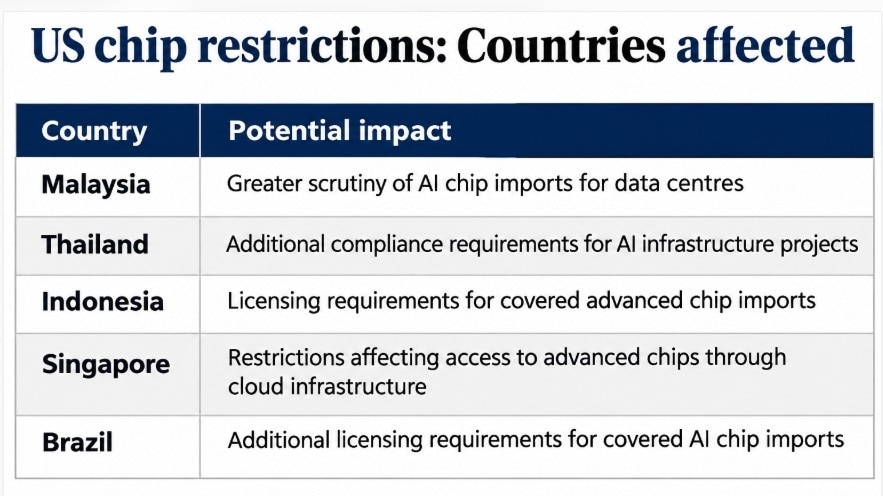
According to Jefferies' GREED & fear report dated November 19, the US Bureau of Industry and Security (BIS) has introduced export licensing requirements for AI chips shipped to Malaysia, Thailand, Indonesia, Singapore and Brazil, except for qualifying exports to US companies.

The restrictions could reshape global semiconductor supply chains and raise fresh questions about the sustainability of the AI investment boom.

Advertisement

Why is Washington tightening chip restrictions?

The latest measures target a potential loophole in existing export controls. Although Chinese companies face restrictions on purchasing advanced American AI chips, they have been able to access computing capacity through overseas data centres.

Jefferies estimates that as many as 240,000 Nvidia AI chips may have been diverted to China since sanctions began in 2024.

MUST READ: US SEC launches probe into potential accounting issues at Nvidia, scrutiny over China ties widen

The report also cites estimates from the Institute for Progress suggesting that Singapore-based Megaspeed has been renting approximately 86,000 graphics processing units (GPUs) to Alibaba and other Chinese customers, potentially through facilities outside mainland China.

The restrictions seek to prevent such indirect access.

Advertisement

How could Nvidia and AI infrastructure companies be affected?

Nvidia faces potential challenges as Washington tightens oversight of semiconductor exports and overseas computing infrastructure.

Jefferies highlights Nvidia's extensive financial involvement in the AI ecosystem, including $61 billion in equity investments and $164.5 billion in lease guarantees and cloud capacity backstops.

A reduction in AI infrastructure financing could affect smaller cloud providers that depend heavily on advanced chips.

CoreWeave, an AI infrastructure company, has already experienced a 25% share-price correction following developments surrounding Nvidia, while its bond yield climbed to 15.7%, according to the report.

Can China build its own semiconductor ecosystem?

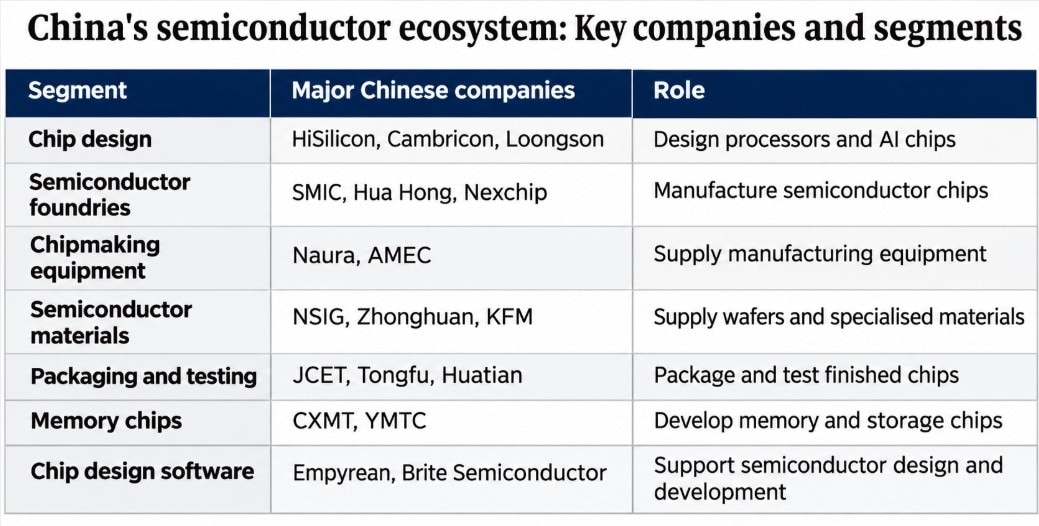
China has been accelerating efforts to reduce its dependence on American technology by developing domestic capabilities across semiconductor design, manufacturing, equipment and materials.

A semiconductor supply-chain map from Goldman Sachs Global Investment Research highlights Chinese companies operating across these segments.

In chip design, companies such as HiSilicon, Cambricon and Loongson represent domestic capabilities, while SMIC and Hua Hong operate in semiconductor manufacturing.

Advertisement

Equipment suppliers include Naura and AMEC, while NSIG and Zhonghuan feature in semiconductor materials.

ALSO READ: Nvidia after Jensen Huang: Can the AI giant keep its innovation edge?

The graphic estimates China's semiconductor equipment market at $49 billion and materials market at $16 billion in 2025, illustrating the scale of the domestic supply-chain opportunity.

However, the presence of domestic suppliers does not necessarily establish technological parity with leading global manufacturers.

Why Southeast Asia matters

Southeast Asia has emerged as a major destination for AI infrastructure investment.

Malaysia has announced 61 data centre projects since 2023, with potential electricity demand reaching 8.35 gigawatts.

Thailand, meanwhile, recorded a 64% increase in approved foreign investment during the first nine months of 2026, with digital infrastructure accounting for approximately two-thirds.

ALSO READ: Nvidia CEO Jensen Huang, wife moves $10.7 billion worth of shares into family trust

Tighter export controls could complicate these investments, particularly where Chinese financing or customers are involved.

What does this mean for global markets?

Advertisement

The restrictions could encourage semiconductor supply-chain diversification while increasing compliance costs for cloud providers.

For investors, the central question is whether China's growing semiconductor self-reliance can offset restrictions on advanced American technology without slowing AI development.

DO READ: Trump admin cleared 9 lakh AI chips for Chinese tech giants despite Pentagon concerns: House Committee

For Unparalleled coverage of India's Businesses and Economy – Subscribe to Business Today Magazine

ABOUT THE AUTHOR

Basudha Das
Basudha Das

With over 16 years of experience in the newsroom, I am currently covering personal finance, banking, financial services, and insurance sector, bullion and metals, sports, and other trending topics. When not chasing interest rates and new-age investment tools, I like to follow and cover climate change trends and environment-friendly initiatives across the world. When not at work, I spend time learning Bharatnatyam from my guru, and baking from my daughter.

Published on: Nov 21, 2026 2:08 PM IST