












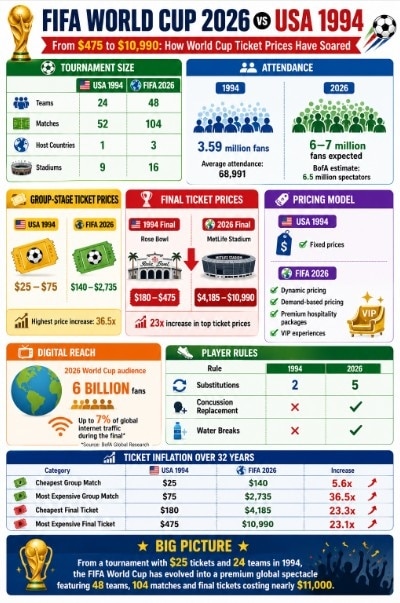



 The 2026 tournament, which will be hosted by the United States, Canada and Mexico from June 11 to July 19, is expected to be the largest in the competition's history.
When the FIFA World Cup last came to North America in 1994, fans could watch first-round matches for as little as $25 and secure a seat for the final for a maximum of $475. Three decades later, attending football's biggest event has become significantly more expensive, highlighting how the World Cup has evolved from a mass-market sporting spectacle into an increasingly premium entertainment product.
The 2026 tournament, which will be hosted by the United States, Canada and Mexico from June 11 to July 19, is expected to be the largest in the competition's history. According to Bank of America (BofA), the event could attract around 6.5 million spectators and engage as many as 6 billion fans through television, streaming and digital platforms, making it the biggest sporting event ever staged.

 Rajiv Kumar pushed for changes at HDFC Bank; Sashidhar Jagdishan chose to step down: Report
  BT EXCLUSIVE: Can the soundbox become a bank branch?
 IPO rush at Dalal Street: Not every issue is worth investing in; how to spot red flags
 How Sun Pharma is avoiding a tariff hit by agreeing to MFN pricing for US Medicaid
 Who is George Kovoor? PepsiCo veteran takes charge as Parle Biscuits CEO
 Modi, Putin, Xi, Pezeshkian At SCO: Is Trump Facing A New Anti-U.S. Power Bloc?
 Two Kerala Women Die In California; Families Await Answers And Their Daughters’ Return Home
 PAK’s Digital Terror Plot: How ISI-Backed Networks Hide Behind Anonymous Online Chats
 RSS Chief’s Mohan Bhagwat’s ‘Vishwaguru’ Message Sparks Political Clash Over India’s Idea Of Service
 Why Are Himalayan Disasters Increasing? Nepal, Uttarakhand & Sikkim Sound The Alarm
 IPO rush at Dalal Street: Not every issue is worth investing in; how to spot red flags
 Sugar stocks: Why Balrampur Chini, Bajaj Hindusthan, Dwarikesh Sugar, others are falling today
 Titan, PC Jeweller, Manappuram Finance, Kalyan Jewellers shares fall up to 7% post PM Modi's appeal
  GIC Re shares: Why Angel One sees 25% upside on this PSU reinsurer
 Tata Elxsi shares climb after pact with Sarla Aviation for Shunya aircraft; details here
 John Ternus net worth: Apple CEO’s salary, career and estimated $75 million fortune revealed
 Anthropic resumes Claude testing after real-world hacks, adds stronger AI safety safeguards
 From ₹10 lakh on day 1 to ₹45.63 crore lifetime: The miracle of 'Hanuman Ansh' at box office
 Achieving Financial Goals with Lifecycle InvestingIPO rush at Dalal Street: Not every issue is worth investing in; how to spot red flags


