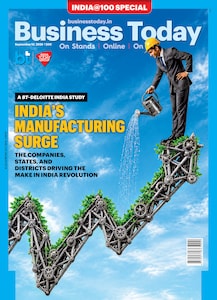
BT India@100, Business Today’s special annual edition, is back and this time the spotlight is on India’s manufacturing ambitions. The BT India@100 2026 special issue, “India’s Manufacturing Surge”, explores the companies, states and districts driving the Make in India revolution, and asks whether manufacturing can become the foundation of a truly developed India by 2047.
The issue takes a deep dive into India’s manufacturing ecosystem at a time when global supply chains are being redrawn and economic security is back at the centre of the conversation. While manufacturing’s share of GDP remains around 16%, new industrial clusters, expanding supply chains, rising exports and investments in sectors such as electronics and semiconductors point to a transformation on the ground. A BT-Deloitte India study identifies the companies leading India’s manufacturing transformation, including India Inc. titans such as ITC Chairman & MD Sanjiv Puri, Maruti Suzuki MD & CEO Hisashi Takeuchi and Jindal Power Chairman Naveen Jindal.
BT Research maps the states at the forefront of the race, with Gujarat leading on several investment and export parameters, Uttar Pradesh emerging as a major challenger, and Tamil Nadu remaining a manufacturing powerhouse. The issue features Uttar Pradesh CM Yogi Adityanath, Gujarat CM Bhupendra Patel, Haryana CM Nayab Singh Saini, and Maharashtra CM Devendra Fadnavis, as it looks at the states powering India’s manufacturing rise.
An analysis by How India Lives goes deeper into the districts powering production and exports, with 69 districts exporting more than $1 billion each in manufacturing goods in FY26. Also, discover the sectors and emerging manufacturing hubs shaping India’s next phase of growth, the reforms needed to make Indian factories globally competitive, and why India must chart its own manufacturing path rather than replicate China’s model.
All this and more in the latest India@100 Special issue of Business Today Magazine. Out on stands now.
SUBSCRIBE NOW

 by Siddharth Zarabi
 by Palak Agarwal


 Latest News


 Planning to buy a car in 2027? India’s new CAFE-III rules could shape the petrol, hybrid and EV choices ahead
 Yami Gautam brings a mysterious bride into a chaotic Meerut home in Nayyi Navelli, releasing October 16
 Arjun Das and Aishwarya Lekshmi lead Netflix’s #Love: Rival dating apps, one challenge and an October 2 premiere
 Gemini 4 Argon is built for longer work tasks: Google’s announced features, API prices and access limits
 Stuck at Delhi traffic lights? A ₹1,789.52-crore plan aims to change signal timings across 42 corridors