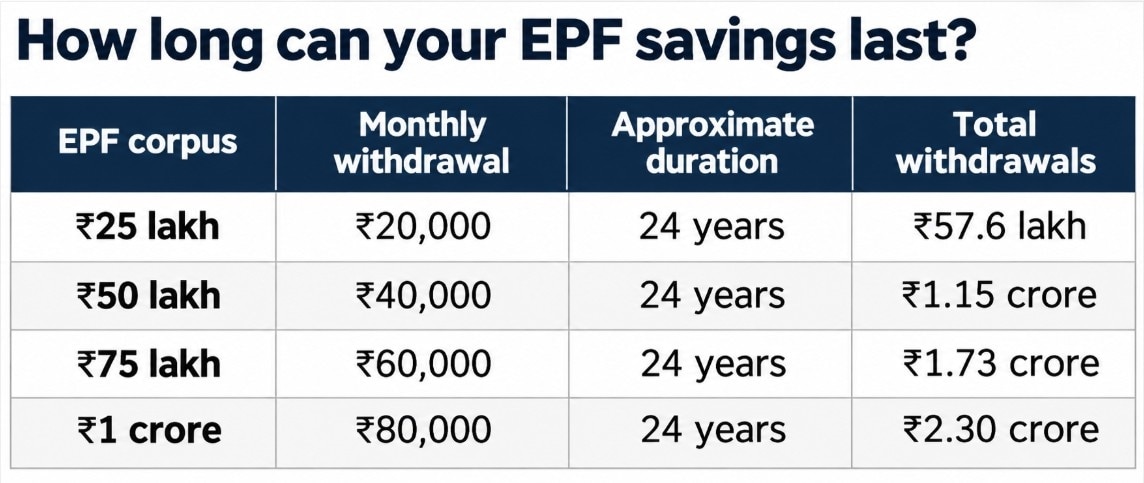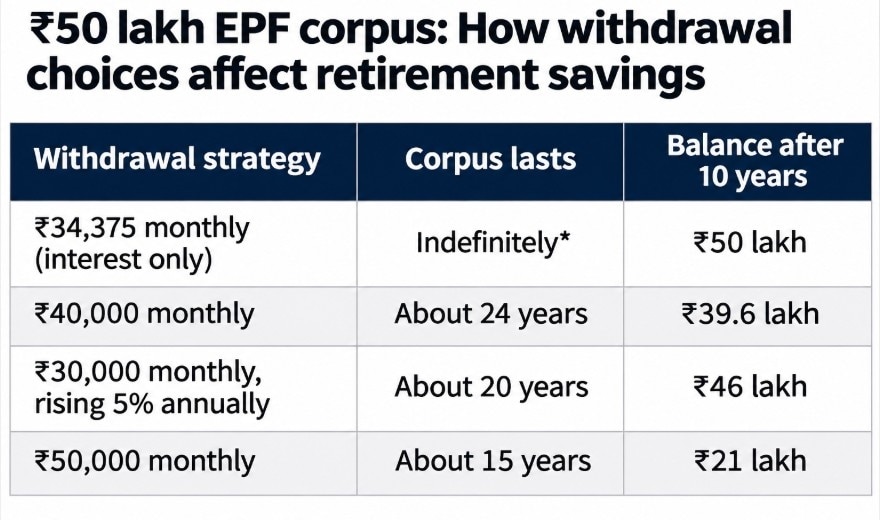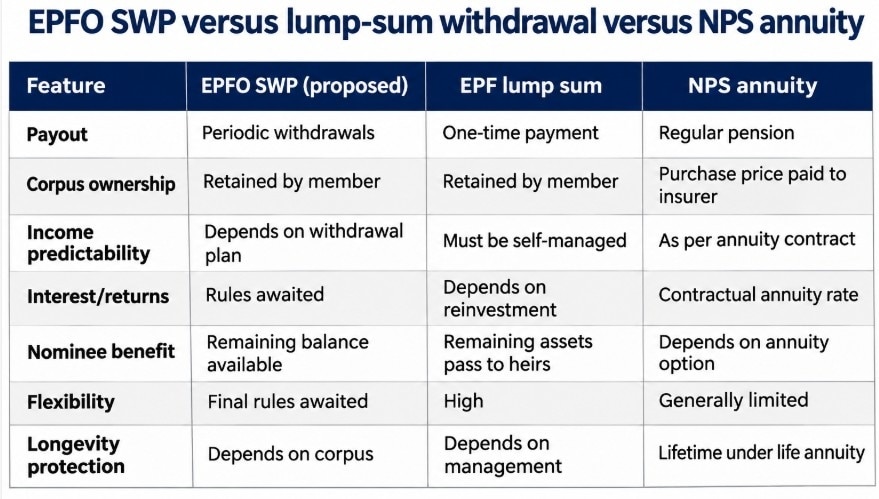









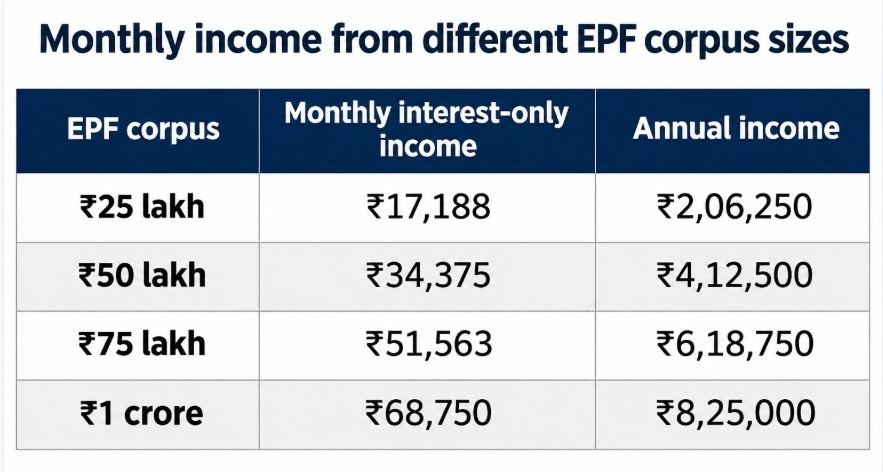



 The proposed SWP could offer retirees greater control over their savings, but its attractiveness will ultimately depend on EPFO's final implementation rules.
The Employees' Provident Fund Organisation's Central Board of Trustees (CBT) approved the introduction of an SWP on November 19, marking a significant change in how employees could access their retirement savings.
Under the proposed mechanism, retiring members would receive periodic withdrawals while retaining ownership of their remaining EPF corpus. However, the detailed operational rules, including interest treatment and withdrawal flexibility, are yet to be finalised.

 Bulk Scotch whisky imports: Tariff classification and not revenue considerations at heart of the logjam
 'Nothing but a change of mind': Venu Srinivasan's lead counsel counters Lakshmi's claim in TVS dispute
 'CEO pay hiked massively, starting salaries barely beat inflation': Mohandas Pai hits out at India Inc
 India steps up maritime security for seafarers amid vessel attacks; 9 ships under monitoring near Hormuz
 India to power over 90% of South Asia's export growth: Can it become the region's manufacturing hub?
 Eigen AI Can Improve Efficiency Of Complex Industrial Tasks By About 50% : Siemens CEO
 TVS Family Dispute: Venu Srinivasan’s Side, Explained by Abhishek Manu Singhvi
 Why Are Tata's Top Leaders Stepping In As Air India Struggles With Losses And A Long Turnaround Now?
 GE Sends 15th F404 Engine To India: Can HAL Deliver Tejas Mark-1A By March 2027?
 What Is Siemens S3 Passenger? The Technology Transforming Railway Ticketing & Reservations

 FIIs pump over ₹1 lakh crore into Indian equities in November as Nifty crosses 25,500
 Anthropic's $1.5 trillion valuation surpasses combined m-cap of India's top 10 companies
 Aurionpro Solutions wins Rs 100-crore order for AI-ready data centre in Southern India, check stock reaction
 Poonawalla Fincorp to issue non-convertible debentures worth up to Rs 500 crore
 Punjab National Bank shares close 4% higher as Moody's affirms Baa3 ratings
 Bangladesh's textile export growth to outpace Pakistan by over threefold through 2035: Report
 Delhi HC rules Mauritius fund's ₹593 crore mutual fund gains cannot be taxed as Indian share sales
 India's growth could slow in second half of FY27: BNP Paribas identifies key warning signs'Nothing but a change of mind': Venu Srinivasan's lead counsel counters Lakshmi's claim in TVS dispute'CEO pay hiked massively, starting salaries barely beat inflation': Mohandas Pai hits out at India Inc