The weak monsoon rains this year, which impacted kharif crops in several states, could impact the microfinance industry, delaying its turnaround, which had only just begun.
The industry, which saw an aggressive expansion in its loan portfolio in the post Covid years between 2021 and 2024, went through a phase of consolidation, and rapid customer acquisition gave way to credit risk management over 2025-26.
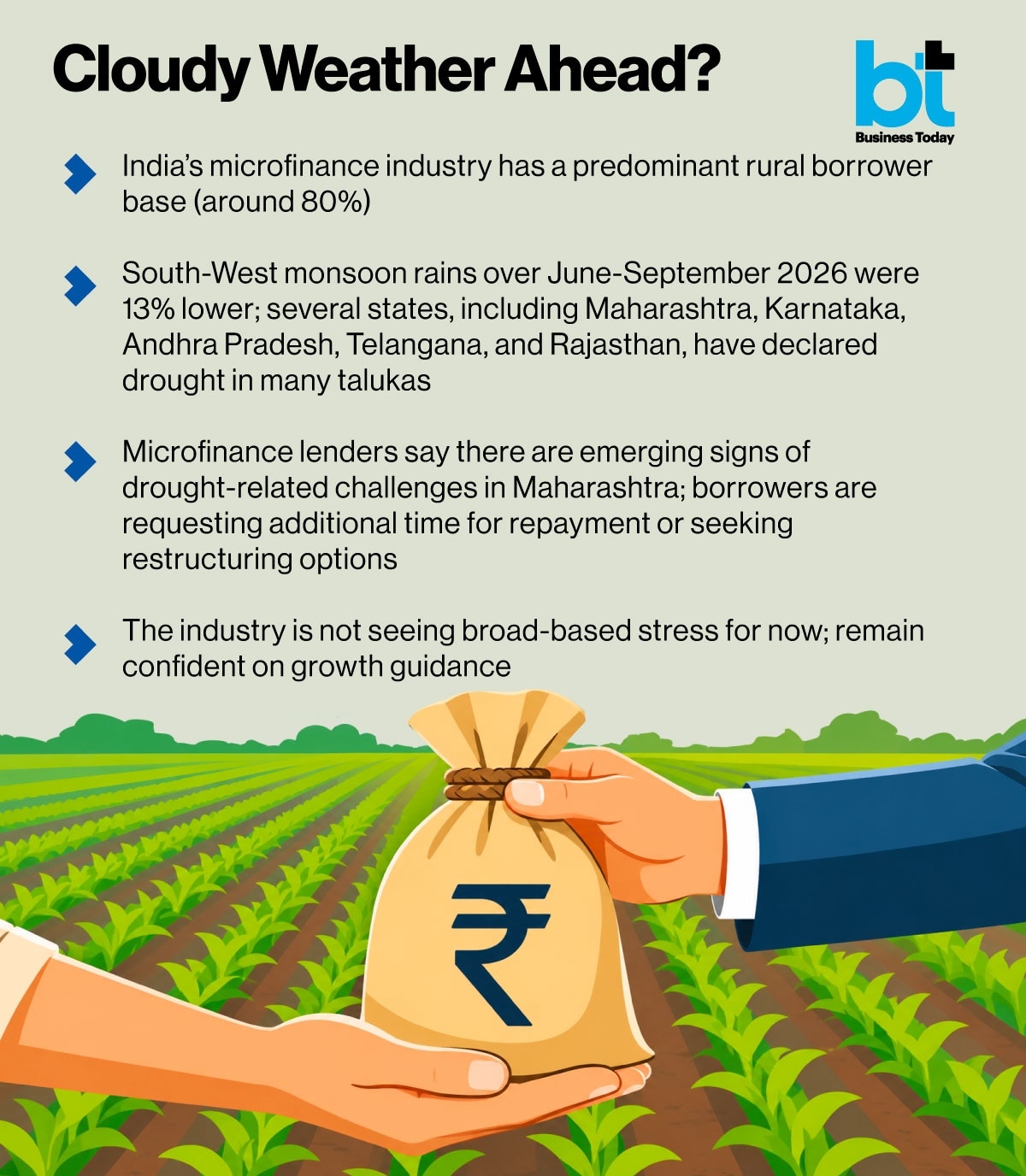
However, El Niño has cast a dark shadow on the sector which was showing signs of a turnaround after Covid. The southwest monsoon, during the June-September 2026 period, ended with a deficit of around 13%. While that may sound modest, problems are arising in several states. Maharashtra, for instance, has declared drought in 265 out of the 358 talukas in the state.
Neighbouring Karnataka has also declared 226 talukas as drought-hit. Drought has also been declared in parts of Andhra Pradesh, Telangana and Rajasthan.
MUST READ: Microfinance sector’s gross loan portfolio reaches ₹3.28 lakh crore but there’s a flipside
Microfinance institutions, or MFIs, have a predominantly rural borrower base and higher dependence on agriculture-linked incomes. According to S&P Global, as of March 2025, about 80% of MFI loans were rural, with 35% exposure to the agriculture sector, 9% to agro-based enterprises, and 20% to animal husbandry. However, it also noted that only part of the rural portfolio is directly linked to crop incomes, which reduces the sensitivity of overall asset quality to rainfall outcomes. S&P Global has anticipated a dip in agriculture-linked asset quality with MFIs, as they are far more vulnerable than banks.
Companies are also admitting to emerging signs of stress due to the drought. However, the impact so far is only visible in Maharashtra, and companies elsewhere are watching the developments closely. They are also taking a more cautious approach in some of these markets to avoid building up additional stress.
One such microfinance institution is CreditAccess Grameen. “We are seeing a few signs of drought-related challenges in October around certain pockets of Maharashtra, wherein the borrowers are requesting additional time for repayment, including restructuring options,” says Ganesh Narayanan, its MD and CEO.
Nilesh Dalvi, the company’s CFO separately notes that even though historically they have not had any significant impact due to the drought, this year, the widespread nature of the situation calls for greater vigilance. He adds one would also have to be watchful of the northeast monsoon (October-December).
Sanjay Garyali, the MD and CEO of Fusion Finance, also agrees that there is an impact in Maharashtra, where it has a portfolio of around Rs 120 crore, or about 2% of its overall assets. Its collection efficiency has marginally reduced to around 98.7% due to the drought conditions.
“Our customers are not farmers. They do have farm income, but that may be around 10-20% of their income. So, they do get impacted due to the drought, but we do not see cash flows really getting impacted. What we are seeing is customers holding back certain payments, as they are not very clear about how the drought situation is going to pan out,” Garyali says. The microfinance lender is taking steps to ring fence its branches in these areas.
ALSO READ: Gold prices correct: Jewellers may gain, but will gold loan growth and lender margins take a hit?
Companies, for now, are not focusing on fresh customer onboarding in some of the affected areas.
Let us rewind a little. India’s microfinance sector has had to go through a hard reset. In the post-Covid years, the industry had been seeing strong growth, and the pandemic-era stress was largely behind. In the quest for growth, MFIs lent indiscriminately, and borrowers took more loans from multiple institutions simultaneously. By the end of March 2024, the total loan portfolio of
MFIs touched Rs 4.43 lakh crore. There were 87 million MFI borrowers and around 5.6 million active MFI borrowers had loans from four or more lenders. This resulted in excessive exposure and leverage. Then delinquencies rose.
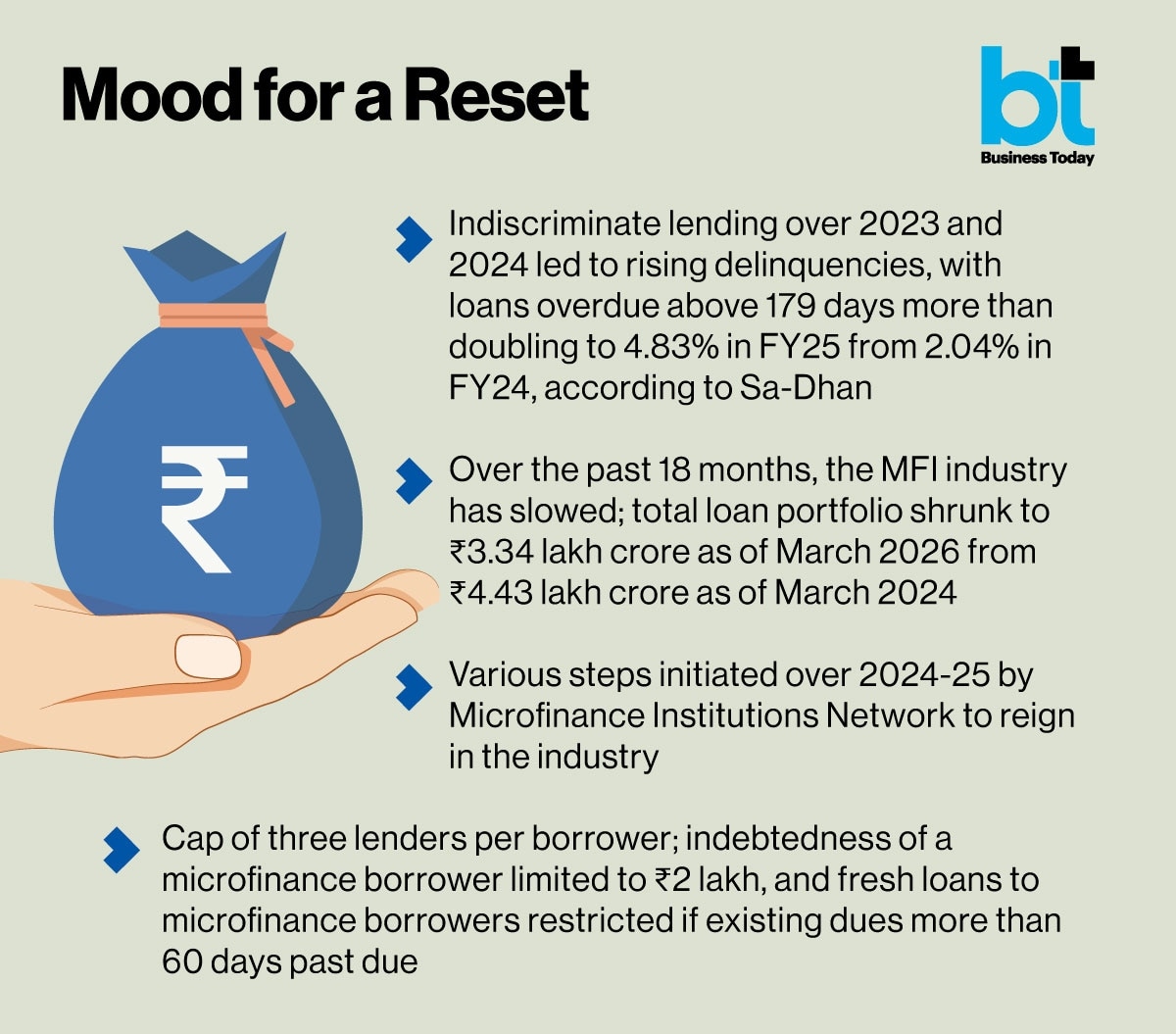
Multiple loans strained borrowers’ repayment capacity. Loans overdue above 179 days more than doubled to 4.83% in FY25 from 2.04% in the previous year, according to Sa-Dhan, the self-regulatory organisation for MFIs.
Asset quality deteriorated, with credit ratings agency ICRA reporting overall stress (including special mention accounts, gross non-performing assets, write-offs, and security receipts) surging to 15.3% in 2024-25, compared with 5.9% as of March 2024.
As troubles rose, several steps were initiated to curb the industry excesses. A cap of three lenders per borrower was introduced, a limit of Rs 2 lakh in microfinance as well as unsecured retail loans per borrower was placed and fresh loans to borrowers whose loans had been overdue for more than 60 days were restricted. Furthermore, all registered entities would need to submit data to credit bureaus.
Following the guardrails, growth for the MFI sector slowed in 2025-26, but importantly, it controlled indiscriminate lending. Credit quality improved. But at the end of March 2026, the total loan portfolio of MFIs stood at Rs 3.34 lakh crore, almost 25% lower from March 2024.
DO READ: Gold-loan NBFCs stare at tougher competition as banks enter the market
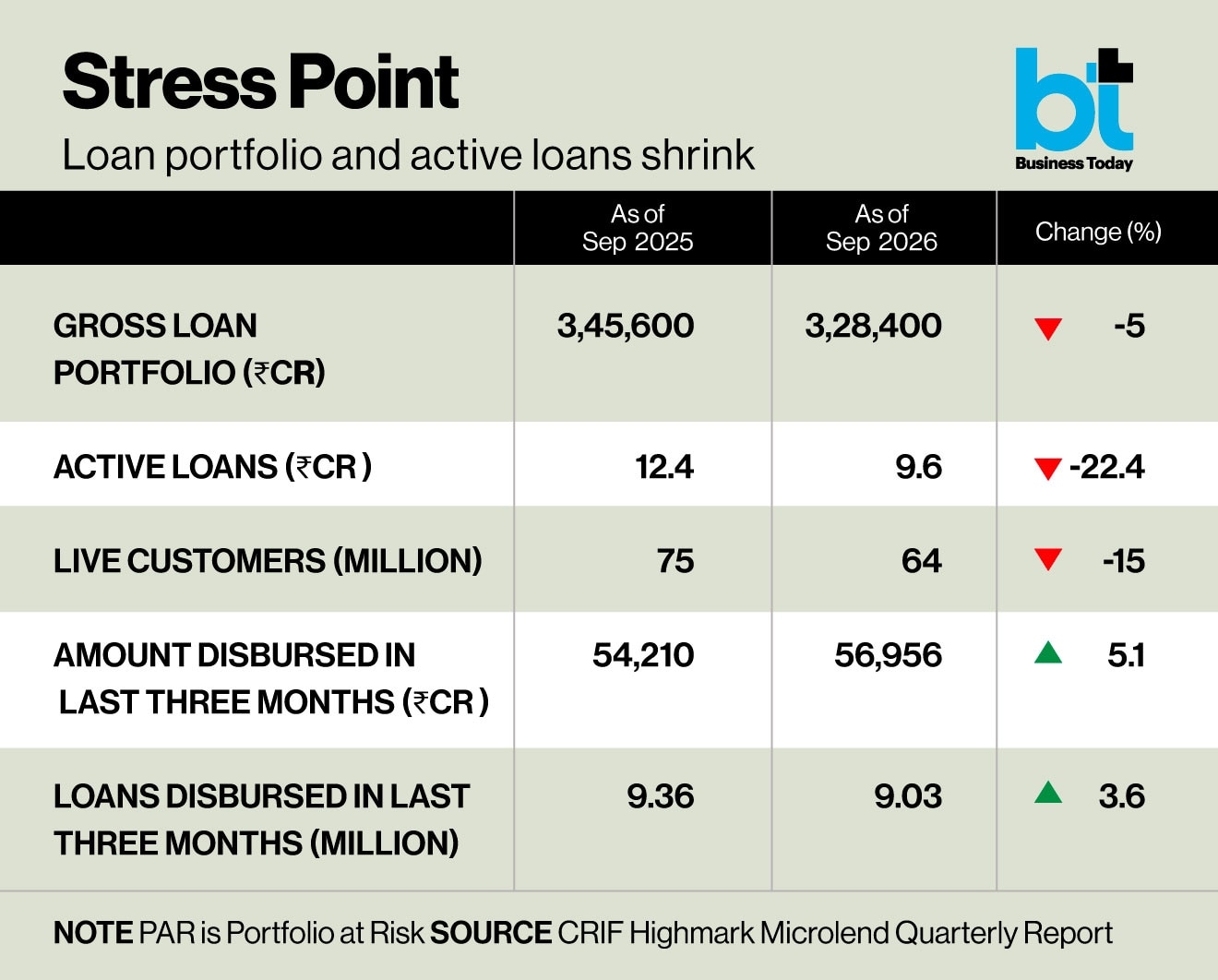
According to latest data from credit information bureau CRIF Highmark, the gross loan portfolio of the industry declined to Rs 3.28 lakh crore as of September 2026, down 5% from a year ago. However, it’s not all gloomy. There has been a marked decline in portfolio at risk (PAR) between 31 and 180 days at 1.6% as of September 2026 from 4.6% in September 2025 and 6.4% in December 2024. Loan delinquencies have also been stable below 1%. PAR between 91 and 180 days was at 2.7% in September 2025.
The guardrails put in place will help the industry navigate any emerging drought-borne stress, say analysts.
“Most of the disbursements that would have happened in last 12-18 months came on the back of tightened norms. So, this culminating in a major stress like three years ago is not probably a top-of-mind concern for us now. If there are two repeated cycles of droughts, then this can maybe become a challenge,” says Deep Inder Singh, Vice President and Co-Group Head, ICRA.
The sign of a turnaround is also reflective in the September-quarter, or Q2 FY27, earnings of leading microfinance companies. CreditAccess Grameen, the country’s largest NBFC MFI, saw its net profit surge to Rs 502 crore from Rs 126 crore a year ago, while revenue rose 26% to Rs 1,904 crore, from Rs 1,509 crore. Its assets under management have grown 20% from a year ago to Rs 30,946 crore.
Elsewhere, Fusion Finance swung to a net profit of Rs 86.5 crore in July-September, compared with a Rs 22 crore year-ago loss, aided by a dip in credit costs. Its revenue from operations rose 17% to Rs 486 crore from Rs 416 crore. Its AUM has crossed Rs 8,000 crore during the quarter, rising 14% from a year ago.
“There are two big lessons we have learnt from the [previous] crisis. Customer assessment is key. Also, do not rush for business or disbursements, but keep monitoring things on the ground and keep calibrating; be agile,” says Garyali of Fusion Finance.
The company is strengthening its credit underwriting through differentiated credit templates and more rigorous customer assessment.
In 2025, the Reserve Bank of India lowered the minimum amount of microfinance loans that specialised MFIs must hold—from 75% to 60%. This is proving to be a catalyst for MFIs that are expanding into or increasing focus on new business segments. This helps MFIs diversify and safeguard themselves from any crisis that could arise in any particular segment.
Companies are also increasingly focusing on individual loans and not just joint liability group (JLG) ones. They believe retail loans will be a growth driver. JLG loans, common for MFIs, are loans typically given to a small group of borrowers (usually 4-10 people), say small farmers, artisans, micro-entrepreneurs, etc.
DO READ: India’s hidden stimulus: How a ₹33-lakh-crore gold stockpile could boost consumption
“In the individual loan segment, ticket sizes are larger. So, it is going to be larger ticket sizes to the customers who have moved from microfinance to retail loans and kind of disbursements into newer product segments (which will drive growth),” says Singh.
CreditAccess Grameen has expanded mortgage loan offerings from 120 branches to around 428 branches. “We expect to scale up a few hundred branches every year as we gain more experience and train our employees. So, growth will be a combination of microfinance and retail. Retail will grow faster,” says Narayanan.
Fusion Finance, on the other hand, is expanding secured lending to MSMEs. The company has added two segments—Rs 25-50 lakh, and in certain states where it was doing loans of up to Rs 15 lakh, it has now increased the limit to Rs 25 lakh, Garyali says.
The other area of focus for the company is on lending to the premium JLG segment, where income is greater than Rs 3 lakh. Garyali is confident of the company growing its AUM at a compounded annual rate of 20-25%.
“We are entering the next phase of growth with a focus on building a more diversified and resilient franchise. This will be supported by disciplined underwriting, very strong credit costs, continued investment in technology and strong commitment to sustainable and profitable growth,” he says.
Another leading NBFC MFI, Muthoot Microfin, is also stressing on a diversified lending portfolio, bringing down loans in the traditional JLG segment. According to CEO Sadaf Sayeed, in comparison to the 70:30 mix that the company had targeted by the end of March 2027, non-JLG loans have already grown from 17% to 31% of its AUM in the first six months of the current financial year.
Singh of ICRA notes that MFIs already have the kind of franchise and branch network to drive an expansion, even as they become cautious on certain geographies.
The true test of MFIs—a backbone of the country—will, therefore, lie in strengthening customer bases even as they grapple with near-term scares.
DO READ: Why festive shoppers are choosing loans over savings. Expert explains the changing borrowing pattern















 The weak monsoon rains this year, which impacted kharif crops in several states, could impact the microfinance industry, delaying its turnaround, which had only just begun.

 Jensen Huang says he is ready to return as Nvidia CEO, leaves decision to board
 Tata Sons IPO row deepens: Darius Khambata challenges Venu Srinivasan, Vijay Singh over U-turn, says report
 India's health habits are changing: 90% use health apps, 81% willing to pay more for wearable data, finds PwC survey
 Global funds buy Indian stocks despite $3.9 billion offshore withdrawals: Why are investors taking different bets?
 RIL shares among top Sensex gainers, rise over 2%; here's why
 Karnataka CM DK Shivakumar Highlights State's $80 Billion Startup Ecosystem At Bengaluru Tech Summit
 Union Budget 2027 | Govt Eyes Higher CapEx, Jobs & Manufacturing Push: BTTV Sources
 Budget 2027: Ajay Bagga, Ambareesh Baliga Want LTCG Scrap To Boost Market Sentiment
 Markets Stage A Comeback: Can The Bulls Sustain The Momentum? | Arun Kejriwal
 Mahindra XEV 9S Gets 5-Star Bharat NCAP Rating: Check Crash-Test Scores

 Rupee strengthens to highest level since April, hits 7-month high
 Sensex, Nifty extend gains for second session; Nifty Bank hits record high: What lies ahead?
 ITC, HDFC Bank, Vodafone Idea among retail favourites seeing MF buying; Suzlon shares face selloff
 Multibagger Defence stock to buy: InCred see up to 36% upside in Sigma Advnaced despite 9,000% rally
 Tata Sons IPO: Can RBI force the holding company to list despite opposition from Tata Trusts?
 They look harmless, but Nara’s famous deer sent 51 people to hospital this year, over 70% were foreigners
 MS Dhoni IPL salary: How much did CSK legend earn from 2008 to 2026?
 Indian railways shifts 2,200+ trains to new reservation platform: What changes for passengers?
 ₹5 lakh hospital bill: Should you break an FD, withdraw PF, use savings or take a medical loan?