The concerns over earnings quality have become more relevant following the company’s Q2 FY27 performance when BlueStone reported a consolidated net loss of Rs 4.37 crore against a net profit of Rs 5.96 crore in the preceding quarter.
Speaking to Business Today after returning from a long trip, Kushwaha appears composed and measured. He views profitability as a function of the choices a company makes while investing in growth and capacity. He says certain investments may weigh on reported profits without translating into an equivalent cash outflow.
As it fights to shrug off the losses, the bigger question is—can BlueStone make a mark in a market dominated by giants such as Titan-backed CaratLane, especially with volatile gold prices bringing an additional layer of risk?
Building BlueStone
Building this start-up, which seeks to challenge the biggies, has been “insanely interesting”, says Kushwaha. He did not come from the jewellery trade. “I was a developer,” he says. “I have a low threshold for perceiving something as risky,” he says.
This trait will come in handy. BlueStone’s next phase of growth will depend heavily on expanding its physical presence. Kushwaha has set a target of opening around 300 stores by 2030. That will require heavy investment considering he plans to phase out the franchise-owned model.
DO READ: Gold prices are falling. How will it affect your gold loan?
The losses are a worry for now. Rumit Dugar, CFO at BlueStone, says the consolidated figure includes the performance of its young lab-grown diamond (LGD) subsidiary, which is still at an early stage. According to Dugar, the standalone business remained profitable during the quarter, with a profit of Rs 1.7-1.8 crore. He also points to a comparison with the year-ago quarter when the standalone business had reported a loss of Rs 40-45 crore.
BlueStone was built on the belief that jewellery buying was ready for a change. Early investor Prashanth Prakash, Founding Partner of Accel India, recalls the business was little more than an idea when he and Kushwaha started working together.
Prakash recalls smelling opportunity in an industry that had seen limited innovation. Kushwaha’s insight was that online jewellery buying would gain acceptance, while consumers would increasingly look at jewellery as a form of everyday self-expression rather than something reserved for weddings and special occasions.
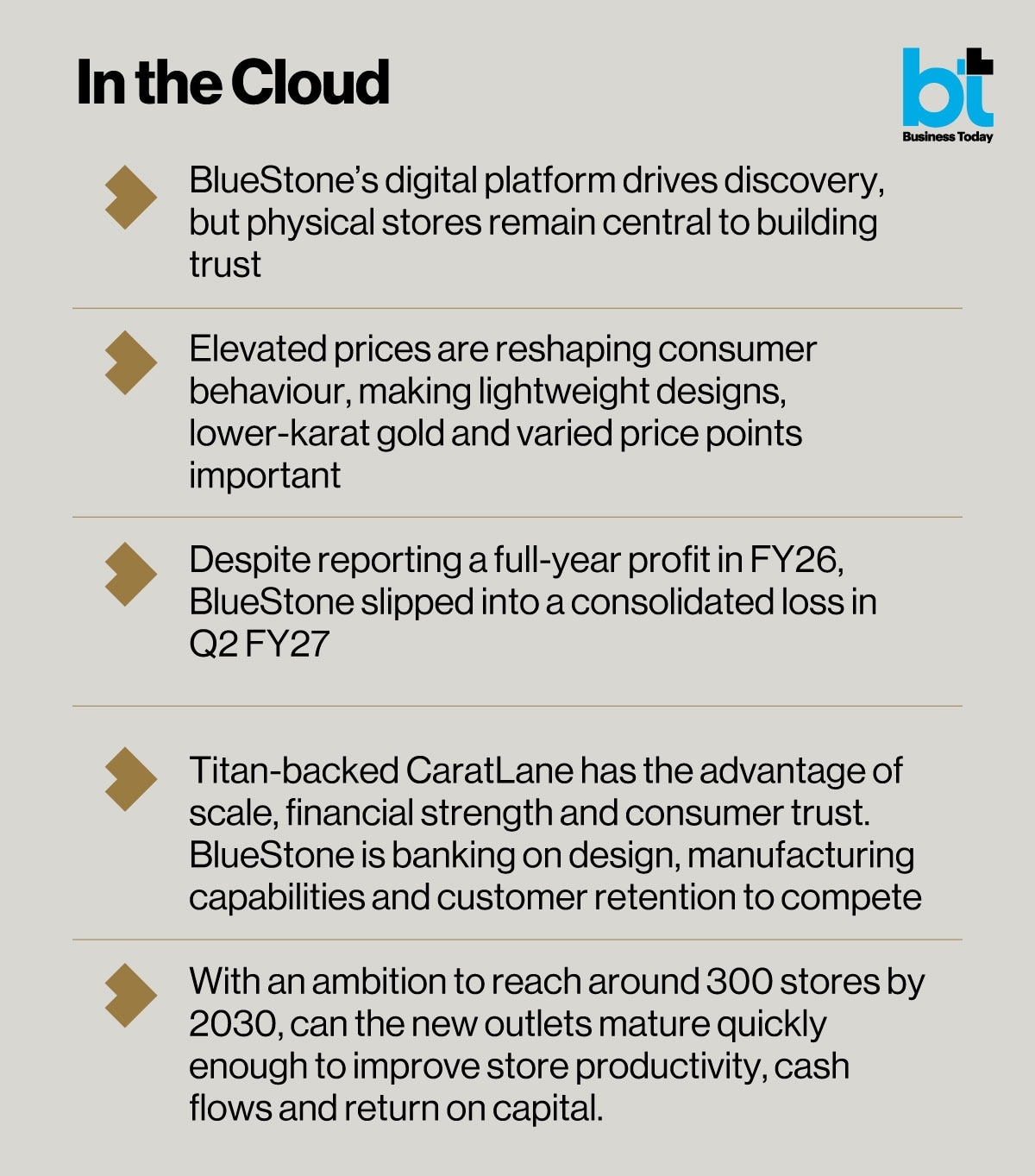
CaratLane, established in 2008, already had a big presence as an early online organised jewellery player. It was acquired by Titan in 2016, with the parent completing its full buyout in FY24. However, BlueStone’s shift from an online-first retailer to an omnichannel player reflects a key reality of jewellery buying that while digital platforms drive discovery, many consumers still prefer physical stores to complete purchases, despite the significant investment required to expand offline.
“Demand aggregation online is a very different game,” says Prakash. “The store is where things get converted. So, the store is a conversion vehicle, but demand generation has not changed.” This combination is central to BlueStone’s expansion strategy. But it also raises the stakes on store economics. Adding outlets is only worthwhile if they attract customers, convert walk-ins and become profitable as they mature.
ALSO READ: Gold crashes from ₹1.45 lakh to ₹1.27 lakh in a month: Why the next 16 days matter for investors
The Gold-Price Test
The challenge is becoming more nuanced as gold prices ease, potentially offering some relief to consumers after a prolonged period of elevated prices. Lower prices could improve affordability and encourage buyers to reconsider the weight, purity and design of the jewellery they purchase.
“BlueStone’s control over design and manufacturing gives it some flexibility,” says Kushwaha. For him, a broad product range, including coloured stones and lower-karat offerings (such as 14-carat and 9-carat gold) can address different price points.
Dugar says the company is focusing on the effect of gold prices on consumer behaviour rather than treating the price movement as a simple revenue tailwind. “The impact of gold prices is actually felt on consumer demand and behaviour,” he says.
That distinction matters. Higher gold prices can increase the value of jewellery sold even when the number of pieces or the volume of gold sold does not rise. For investors, therefore, headline revenue growth may not fully capture the health of underlying demand.
Pawaskar identifies volatile gold prices, competition in lightweight jewellery and inflationary pressure in smaller cities as key risks for the business. He says investors should look beyond revenue growth and track customer additions, repeat purchases and same-store sales to understand the strength of demand.
DO READ: Gold took 26 years, silver 31 years to recover from crashes: What investors should learn
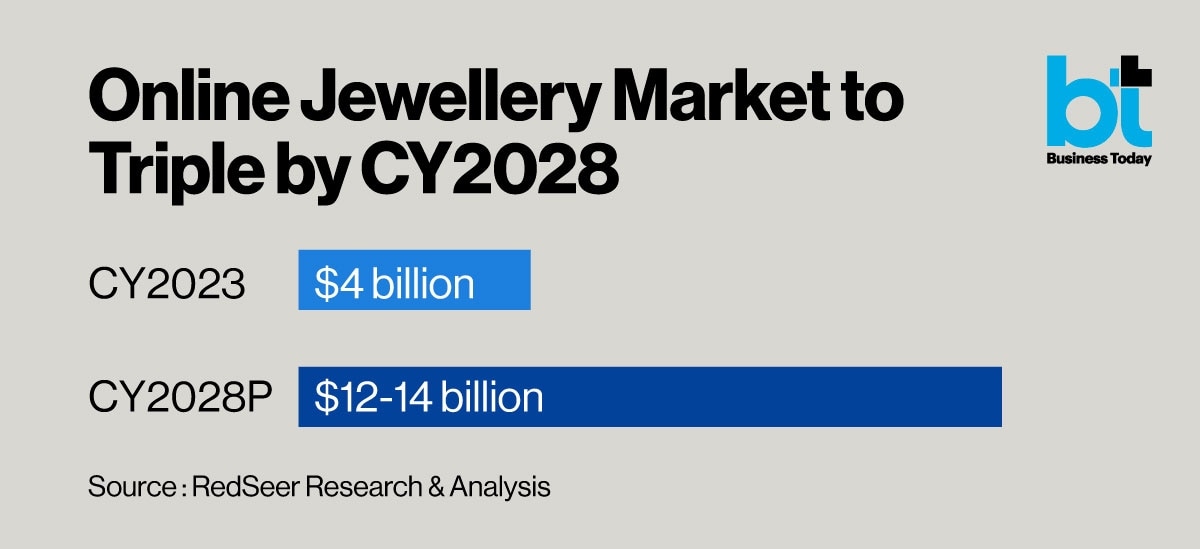
As online penetration grew across various retail categories, the Indian online and online-influenced jewellery market witnessed a staggering growth of 80% between CY 2021 and CY 2023 to reach Rs 30,600 crore, with its contribution to the overall jewellery market at 4-6%, as per RedSeer. This was fuelled by Covid-19, which accelerated digital transformation. The market is projected to grow at a CAGR of 28-30% to reach Rs 1,00,000-Rs 1,10,000 crore by CY 2028.
The company’s longer-term profitability argument rests on operating leverage. As stores mature, their contribution can improve; at the corporate level, a larger revenue base can spread fixed costs. “Vintage drives operating leverage at the store level. Absolute scale drives operating leverage on corporate costs,” says Dugar.
That is the logic behind the company’s expansion—newer stores may initially weigh on margins but should contribute more as they build a customer base and increase sales. The risk, of course, is that expansion can consume cash and inventory before those returns materialise.
The Competition
BlueStone is not operating in an uncontested market. Other players include CaratLane, backed by Titan; Candere, acquired by Kalyan; Joyallukas, Bhima, etc. The traditional jewellers, meanwhile, are investing in contemporary designs and broader retail formats.
ALSO READ: Old gold accounts for up to 60% of jewellery sales: Should you exchange or sell your jewellery?
Dugar says the market remains fragmented and that the two organised, design-led players account for only a small part of the overall opportunity. “The total market share between CaratLane (in online organised precious jewellery market) and us is just 2%,” he says. He also says the revenue gap between the two companies has narrowed over the past three to four years.
CaratLane closed FY26 with a total revenue of Rs 4,690 crore, up from Rs 3,546 crore in FY25, alongside a profit after tax of Rs 268 crore as compared to Rs 167 crore in FY25.
Pawaskar sees BlueStone’s presence in Tier-II and Tier-III markets as one of its differentiators. He points to customer growth and repeat buying as indicators worth tracking.
For investors, the next phase of BlueStone’s story will be less about the number of stores it opens and more about what those stores earn. Pawaskar says investors should monitor store additions, double-digit same-store sales growth, free cash flow and debt-to-equity levels.
Saikat Kumar, Managing Partner and CEO of DIP Market and a board member at Red Lions Capital, is more cautious about the latest results. “Strong revenue growth is encouraging, but the return to losses suggests profitability is yet to become consistent,” he says. The key question, he adds, is whether expansion investments are temporarily weighing on earnings or whether operating margins remain structurally under pressure.
DO READ: Gold, a car or a honeymoon? What ₹10 lakh gets you in wedding season 2026
Kumar also flags the capital intensity of jewellery retail. Inventory ties up substantial funds, making inventory turnover, cash generation and return on capital critical measures of performance. “Revenue growth alone is not sufficient,” he says. “Cash-flow generation and inventory efficiency are the critical variables.”
Kumar says CaratLane benefits from Titan’s financial strength, sourcing capabilities and consumer trust. For BlueStone, he argues, the competitive edge will have to come from product differentiation, customer retention and execution efficiency. Digital capabilities can help with discovery and engagement but stores remain critical to conversion and trust.
As per Kushwaha, competing as an independent player has become more challenging, particularly after CaratLane’s acquisition by Titan.
The early bet on design, technology and everyday jewellery helped BlueStone carve out a place in the market. Its next test is to demonstrate that those strengths can translate into consistent earnings, stronger cash flows and better returns on capital.
ALSO READ: 2,194 gold hallmarking audits missed in five years: Who is checking the labs certifying your jewellery?












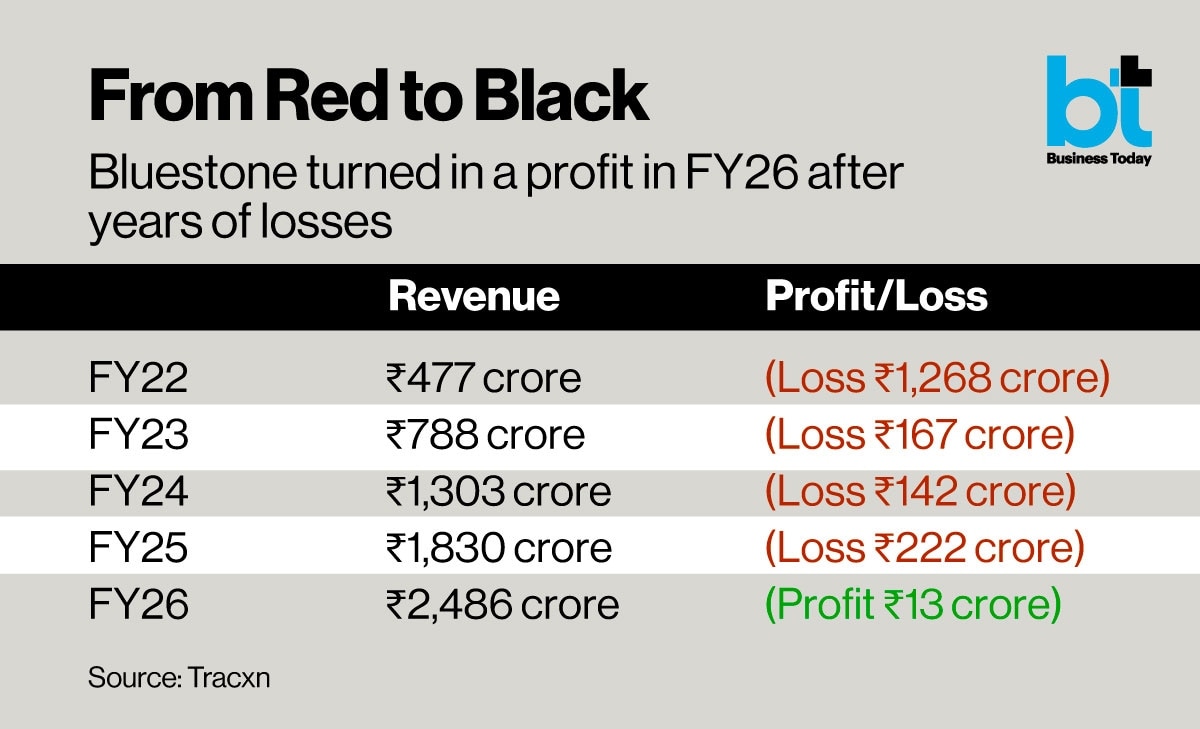



 BlueStone reported a consolidated net profit of Rs 13.2 crore on revenues of Rs 2,436 crore in FY26. This was its first profit in several years.

 US plans fresh tariffs on India, China and other economies over industrial subsidies: Report
 Nasdaq falls as Nvidia slides over 7%, AI stocks retreat after Monday's sharp Wall Street rally
 Nvidia CFO Colette Kress kept out of secret talks over Jensen Huang's return as CEO: Report
 Bisleri says all 143 plants comply with FSSAI norms: What consumers should know about the safety row
 Tata Steel-APL Apollo Tubes deal triggers concerns on X; here's what social media users say
 Silver Hallmarking Push: IBJA Seeks Mandatory Standards, Gold Adulteration Raises Legal Concerns
 Gold, Silver Outlook: Expert Recommends Staggered Buying, Reveals Portfolio Allocation
 Gold Purity Scare: Rhenium Powder Contamination Raises Alarm, Jewellers Seek BIS Intervention
 Which Sectors And Stocks Can Drive Market Returns? Rahul Arora Shares His Top Investment Bets
 Silver Price Crash: How Much Further Can Prices Fall? Expert Flags ₹1.40 Lakh As Key Support

 Nifty outlook: Here's what to expect on November 25 post Monday's crash
 FIIs pour Rs 1.21 lakh crore into equities in November; financials attract biggest inflows: Report
 Suzlon Energy: Record order book, record deliveries but why is the stock falling?
 Nvidia shares fall 3.9% after 30% rally: Why Jensen Huang's return has not ended scrutiny
 Gen Z can’t find jobs, but LinkedIn CEO says AI could give young workers an unexpected advantage
 Changed jobs? Five EPF mistakes that could hurt your retirement savings, pension and tax benefits
 From mortgage stress to ₹32 crore jackpot: Kerala woman reveals what she will do with her lottery fortune
 Buying health insurance? Why a 20% co-payment clause could leave you with hefty hospital expenses
 From waiting for Fridays to making ₹4.6 lakh a month: How an ex-Wall Street trader turned her wardrobe into a business